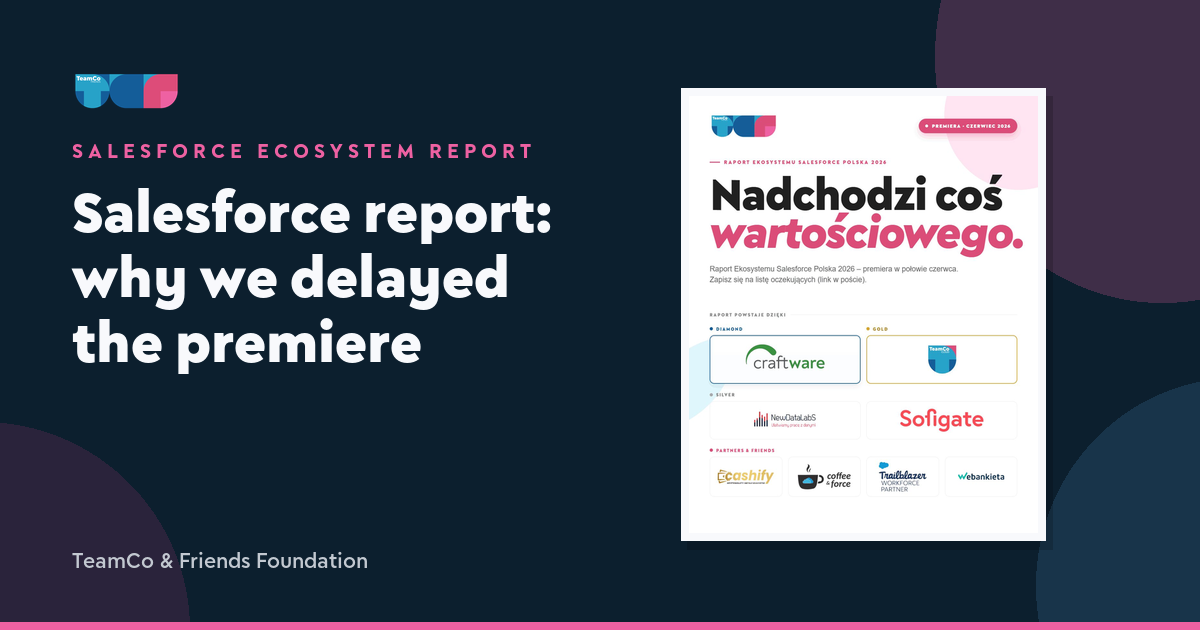
Salesforce report: why we delayed the premiere
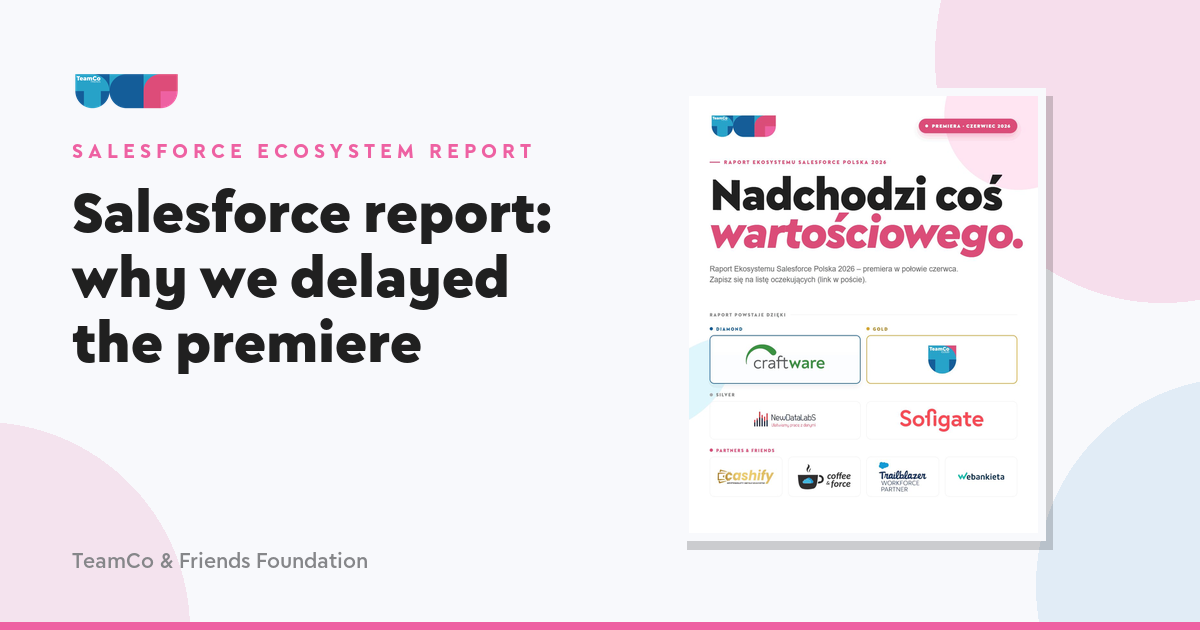
The Salesforce report slipped by a few weeks and we said so plainly. Why we chose quality over the deadline, and what that choice means for the whole community.
Read more31 March 2026
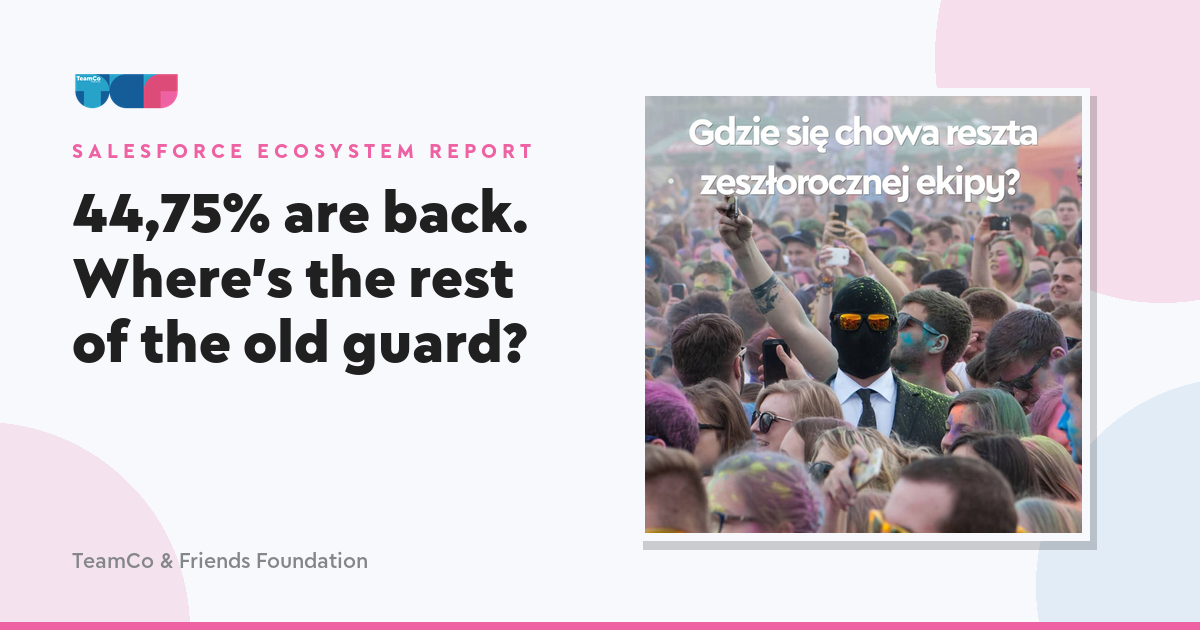
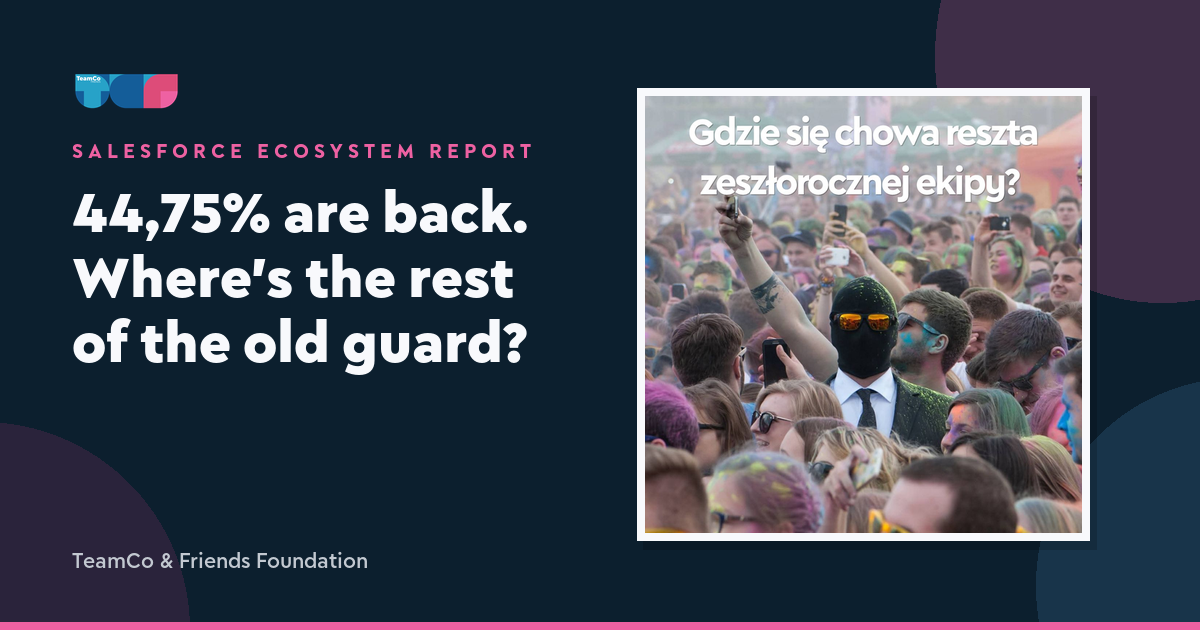
As the Salesforce Ecosystem Report Poland 2026 survey approached 500 completed responses, one figure on the dashboard was more interesting than the turnout itself. According to the Salesforce Ecosystem Report Poland 2026, as of 31 March 2026 44.75% of participants were returning respondents — Trailblazers who had filled in the previous edition and did it again.
That is a good number. And it immediately raises the next question.
Turnout tells you how many people spoke up. Retention tells you whether anything can be compared over time.
A market study answered each year by an entirely different group produces neat bars and useless trends. When the mix of roles, seniority or regions shifts between editions, there is no way to tell whether the market changed or only the sample did. A core group that returns edition after edition is what gives you a reference point — everything else can then be weighed against it.
That is why 44.75% matters more here than the round "almost 500". Nearly half of the responses had a counterpart in the previous edition. That is enough for comparisons to mean something.
Precision matters here, because this figure is easy to misread.
44.75% returning means the remaining roughly 55% of responses came from people taking the survey for the first time. That proportion held throughout the collection period: at 339 responses, 51.95% of participants said it was their first time; at 450 responses, first-timers made up 55.48%.
What the number does not say is what share of the first edition's participants failed to return. Those are two different questions, and confusing them is a classic mistake in reading survey data. We know the share of returning respondents in this year's sample. A drop-off rate for the previous edition does not follow from it directly — that was calculated on the complete dataset and described in the Salesforce Ecosystem Report Poland.
It is honest to say so plainly rather than turn one figure into a stronger claim than it deserves. That principle — publish what the data returned, including when it is less dramatic — matters more in this project than any single headline.
It is worth seeing 44.75% against the whole run of the survey, because that shows something a single result cannot: where the sample came from.
The first milestone was 73 completed responses — exactly 10% of the first edition, which closed at 728 participants. Four months later the survey passed 500. This was not one viral surge but a dozen weeks of steady growth, with someone passing the link on every so often.
That connects directly to retention. A study that grows slowly and in public gives people repeated chances to come back, unlike a campaign that runs for a week and disappears. Nearly half of respondents returning is a product of that rhythm.
It is hard to ask anyone to be candid about pay, seniority and what work in their team actually looks like unless they are certain the answer will never come back with their name on it.
The Salesforce Ecosystem Report Poland 2026 survey is fully anonymous and run with the research partner Webankieta. Nobody inspects orgs (an org is a company's own Salesforce environment) or logs, and answers are analysed only in aggregate. This is not a marketing line but the technical precondition for the data being true at all. The methodology is described on the study page.
The paradox of anonymity runs like this: the less we know about any individual, the more the whole can be trusted. That is why returns are measured by a single declared question inside the survey, not by tracking anyone.
Salesforce specialists have a professional obsession with data integrity. A record with half its fields filled in is often worse than no record, because it looks complete and nobody challenges it. Salesforce has built a whole layer of tooling and training around this, available free on Trailhead, and practically everyone in the ecosystem knows the rule from experience.
A market study works the same way. An abandoned survey is exactly that half-empty record. The group that returns year after year functions as the reference records in this dataset — it keeps the rest of the data honest.
That is the only sensible reason to ask people to come back. It is not statistics for their own sake: a market that knows its own numbers negotiates differently from one that does not.
High retention gives the study something no budget can buy: continuity. It is what makes it possible to talk about change rather than the impression of change.
From the same study we know, among other things, that one in two Salesforce specialists in Poland works for a partner, and that the community is spread across the whole map of the country, not only Warsaw. Neither finding would be worth much as a snapshot from one year. The value appears once it can be compared with the next edition — and that is only possible if the same community returns.
It is also worth remembering when this is happening. Salesforce is rebuilding its platform around artificial intelligence — Agentforce and the wider AI layer are changing the scope of everyday work faster than ever. That is precisely the kind of shift a single edition cannot capture. It needs a series, and a series needs people who come back.
How many participants in the Salesforce Ecosystem Report Poland 2026 survey were returning respondents? As of 31 March 2026, with almost 500 responses collected, 44.75% of participants were people taking the survey again. The remaining roughly 55% of responses came from first-time participants.
How many people completed the first edition? The first edition closed at 728 respondents. The second edition passed 500 responses on 26 April 2026.
Is the survey really anonymous? Yes. The Salesforce Ecosystem Report Poland survey is run with the partner Webankieta, without inspecting orgs or logs. Answers are analysed only in aggregate, and no single response can be tied back to a person.
Where do the results go? Into the free Salesforce Ecosystem Report Poland, published by Fundacja TeamCo & Friends and shared with the whole community.
44.75% is not a result; it is a foundation. It says the study has a core — a group that treats it as an annual duty to their own market rather than another link in a feed.
The question on the original post's cover — where the rest of last year's crew is hiding — stays open, and that is fine, because it is a question about the next edition. Fundacja TeamCo & Friends runs the Salesforce Ecosystem Report Poland so that the ecosystem has its own numbers instead of somebody else's guesses. See how the study works and come back when the next edition opens.
The Salesforce report slipped by a few weeks and we said so plainly. Why we chose quality over the deadline, and what that choice means for the whole community.
Read more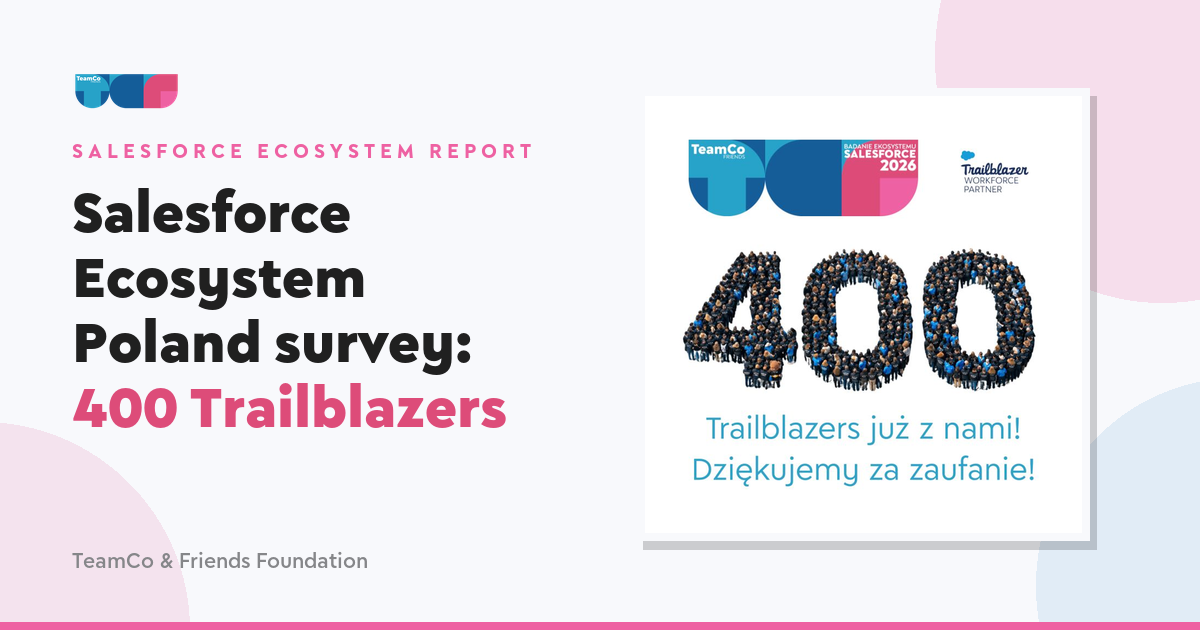
The Salesforce Ecosystem Poland survey passed 400 Trailblazers. See why every anonymous voice genuinely shapes the picture of the Polish Salesforce market.
Read more
The Salesforce ecosystem survey took five minutes and produced hard data on the Polish Salesforce market. See why those five minutes had a real, lasting impact.
Read moreOnce a month, the essentials from the Polish Salesforce ecosystem - data, trends, events. No spam, no ads, just the facts.
Sign-ups coming soon
Join 400+ specialists, managers and leaders from the Polish Salesforce ecosystem who read us every month