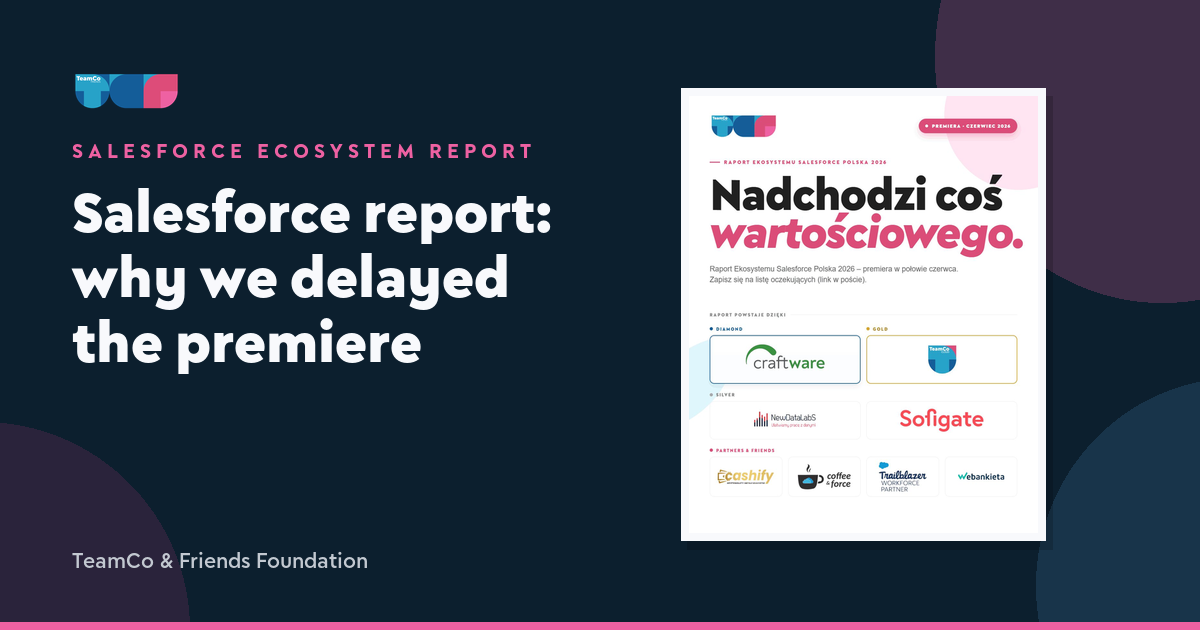
Salesforce report: why we delayed the premiere
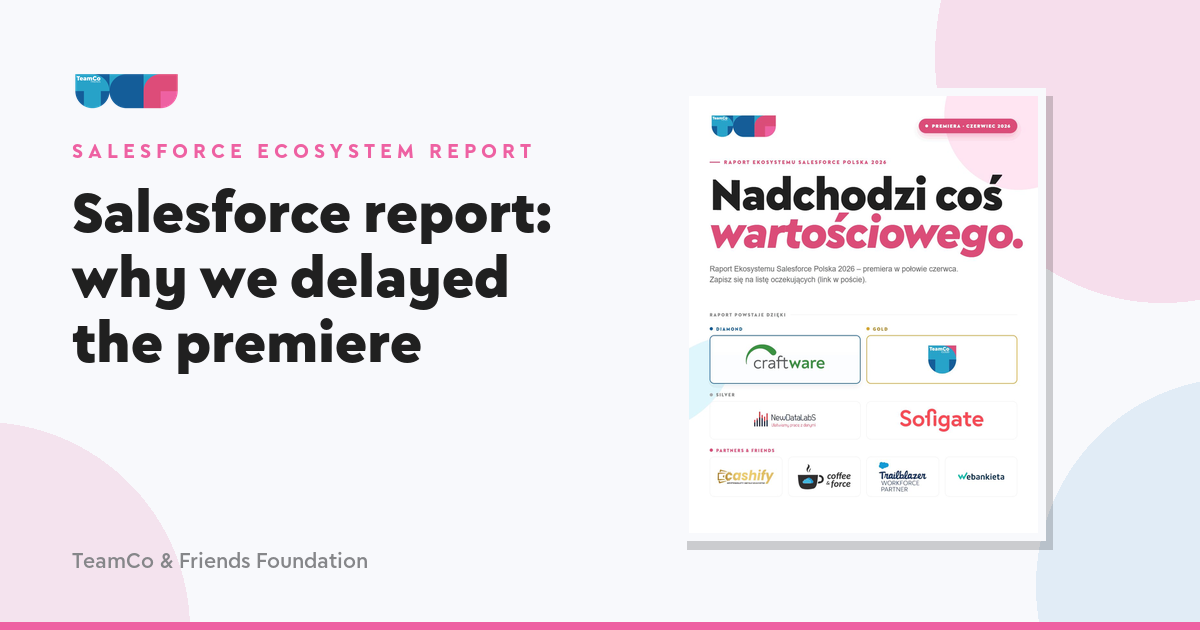
The Salesforce report slipped by a few weeks and we said so plainly. Why we chose quality over the deadline, and what that choice means for the whole community.
Read more30 March 2026
We follow one iron rule: No Bullsh!t. No corporate speak, no sugar-coating. That rule built the Salesforce Ecosystem Report Poland, and it decides what goes into it.
As TeamCo Cloud recruiters, we talk to the entire Salesforce ecosystem, with people at every stage of the journey. As the TeamCo & Friends Foundation, we support those taking their first steps and breaking through their own barriers. We stay close to the community, so we hear everything.
We hear the frustration with job adverts that hide salary ranges. The unclear pressure to return to the office. Rates that do not reflect the hundreds of hours poured into developing skills. But we also hear and see something else: Polish Salesforce specialists rescuing the most complex global projects that others could not deliver.
When we started collecting these stories, hiding salary ranges was a matter of company culture. Today, it is a matter of law. Since 24 December 2025, an employer in Poland has had to tell a candidate the salary, either a fixed amount or a range, no later than before the first interview. Employers may not ask about previous earnings either. This follows from the amendment to the Polish Labour Code of 4 June 2025 (Journal of Laws 2025, item 807).
That changes the starting point of every conversation about money. Before, you had to make the first move, and you were doing it blind. Now the employer has to show their cards first.
Poland is not acting in isolation. The change is backed by the EU Pay Transparency Directive 2023/970, adopted in May 2023, which Member States were required to transpose by 7 June 2026. The next stages are already mapped out: from 2027, large employers will begin reporting their gender pay gaps. If a gap exceeds 5 percent and cannot be justified by objective factors, they will have to assess it jointly with workers' representatives.
In other words, pay transparency is not a passing trend. It is the direction of travel for the years ahead. The question is no longer whether it is coming, but how well prepared we will be.
We do not do it for corporate PR. We do it because we are tired of a market built on guesswork and hallway gossip. We want to give the community a tool grounded in transparency and data, not gut feeling. That is the point of the report: turning "I heard that..." into "I know, because I checked."
If we promise not to sugar-coat the story, we also have to show evidence that does not fit the simple claim that transparency always wins.
Research by Zoë Cullen and Bobak Pakzad-Hurson, published in *Econometrica* in 2023 (NBER Working Paper 28903), found a counterintuitive effect: where pay transparency was introduced within companies, average salaries fell by around 2 percent. The mechanism is simple. When every individual raise becomes visible to the whole team, the company anticipates demands from everyone else and becomes less willing to grant those raises at all.
This distinction matters: the research concerns pay transparency between colleagues, not salary ranges in job adverts. Those are two different things, and honesty requires us to keep them separate. But the conclusion remains: transparency alone does not solve the problem. What makes the difference is transparency plus knowing what your role is genuinely worth on the market. That is exactly what the report is for.
For too long, the Polish Salesforce ecosystem has been framed as a low-cost back office. We want to show Europe and the world something different: Polish specialists set the standard for quality and close the projects others walk away from. The report is meant to be proof, not a slogan.
This is not a niche market. More than 10 million information and communication technology specialists work across the European Union, representing around 5 percent of total employment (Eurostat). Poland is one of Europe's largest markets in this group. The story of a "cheap back office" is no longer supported by the numbers. It survives only through habit.
The 2026 job market does not forgive a lack of knowledge. So the report gives specialists something concrete: data you can put on the table in an interview or a pay-rise negotiation. Not to fight anyone, but to have the conversation with facts in hand. You will find the detailed findings in the Salesforce Ecosystem Report Poland.
The report only carries weight when the community's authenticity stands behind it. It is built on hundreds of responses from Salesforce specialists across Poland, collected anonymously and presented without spin. It is research made by the community, for the community. Learn more about the initiative on the study page and about the mission of the TeamCo & Friends Foundation.
Specifically, 1,003 people took part in the first edition, and 728 completed the full survey. The Polish and English versions of the report were downloaded more than 3,500 times. The second edition, conducted from December 2025 to the end of April 2026, drew 904 participants and 585 complete responses. The survey takes 5 to 7 minutes and is anonymous. We do not collect information that could identify anyone.
Three numbers say more about this market than an hour of debate on LinkedIn:
What is the Salesforce Ecosystem Report Poland? It is an independent study of the Polish Salesforce ecosystem, created by the TeamCo & Friends Foundation in Lublin. It shows the real picture of the market, including skills, trends and working conditions, based on the community's own answers.
Who is the report for? For Salesforce specialists, people entering the ecosystem, and employers and clients who want to understand the Polish market without rumours and guesswork.
What does the "No Bullsh!t" rule mean? It means describing the market as it really is, including difficult topics such as pay and working conditions, based only on data and real community voices, with no PR gloss.
Does an employer now have to put the salary range in the job advert? The law requires employers to tell candidates the salary or salary range no later than before the first interview. It does not require the amount to appear in the job advert itself. In practice, this means candidates should no longer discover the salary at the third stage of recruitment.
What should I do if the salary range is very wide? Ask what determines where someone sits within that range. The rules require pay to be based on objective, gender-neutral criteria. You have the right to understand those criteria, and the report's data helps you check whether the proposed range matches the market.
A transparent market does not build itself. It emerges when we lay our cards on the table without sugar-coating. If you work in the Polish Salesforce ecosystem, the report exists to give you hard arguments where there used to be only hunches.
The law has just shifted the starting point of that conversation in your favour. What you do with that advantage now depends on whether you arrive with the data.
The Salesforce report slipped by a few weeks and we said so plainly. Why we chose quality over the deadline, and what that choice means for the whole community.
Read more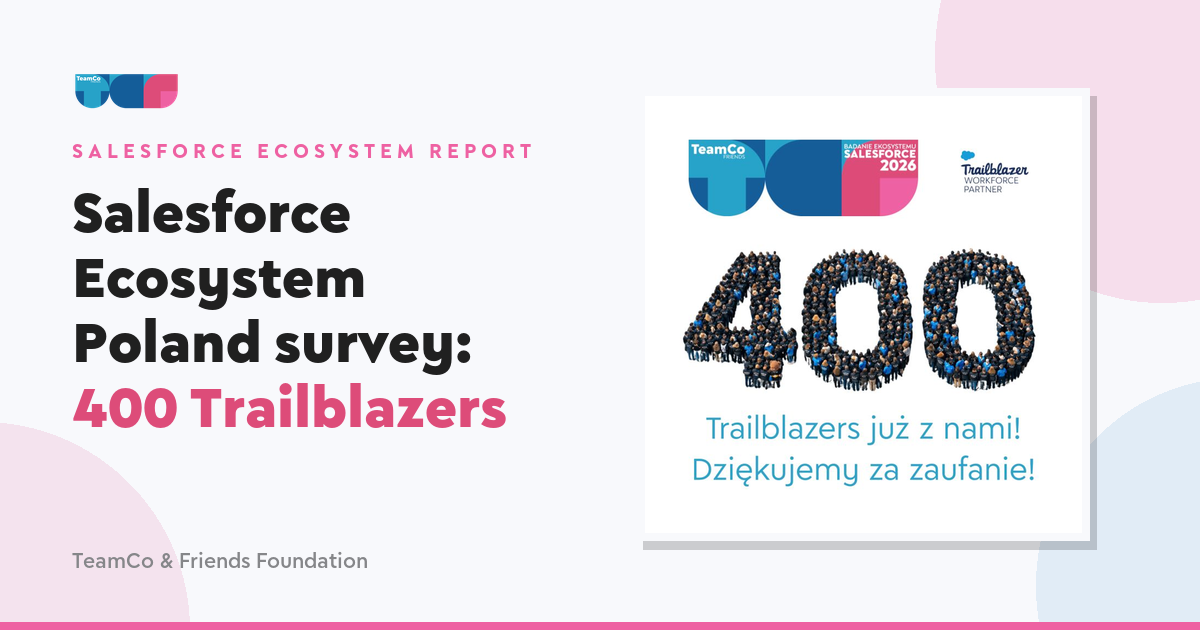
The Salesforce Ecosystem Poland survey passed 400 Trailblazers. See why every anonymous voice genuinely shapes the picture of the Polish Salesforce market.
Read more
The Salesforce ecosystem survey took five minutes and produced hard data on the Polish Salesforce market. See why those five minutes had a real, lasting impact.
Read moreOnce a month, the essentials from the Polish Salesforce ecosystem - data, trends, events. No spam, no ads, just the facts.
Sign-ups coming soon
Join 400+ specialists, managers and leaders from the Polish Salesforce ecosystem who read us every month