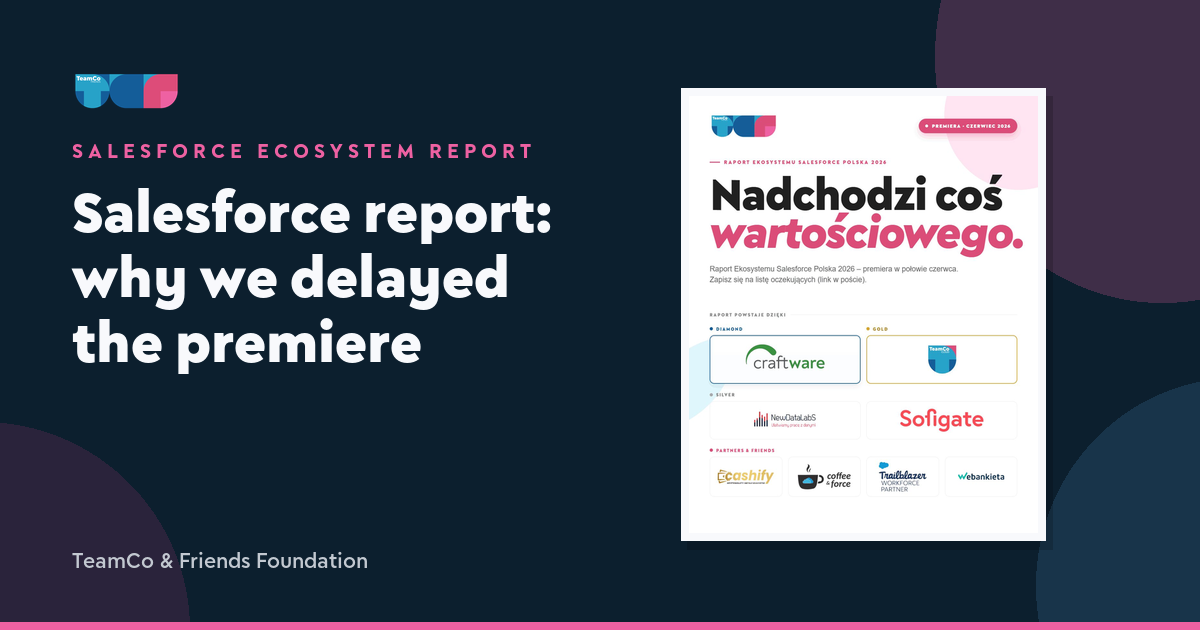
Salesforce report: why we delayed the premiere
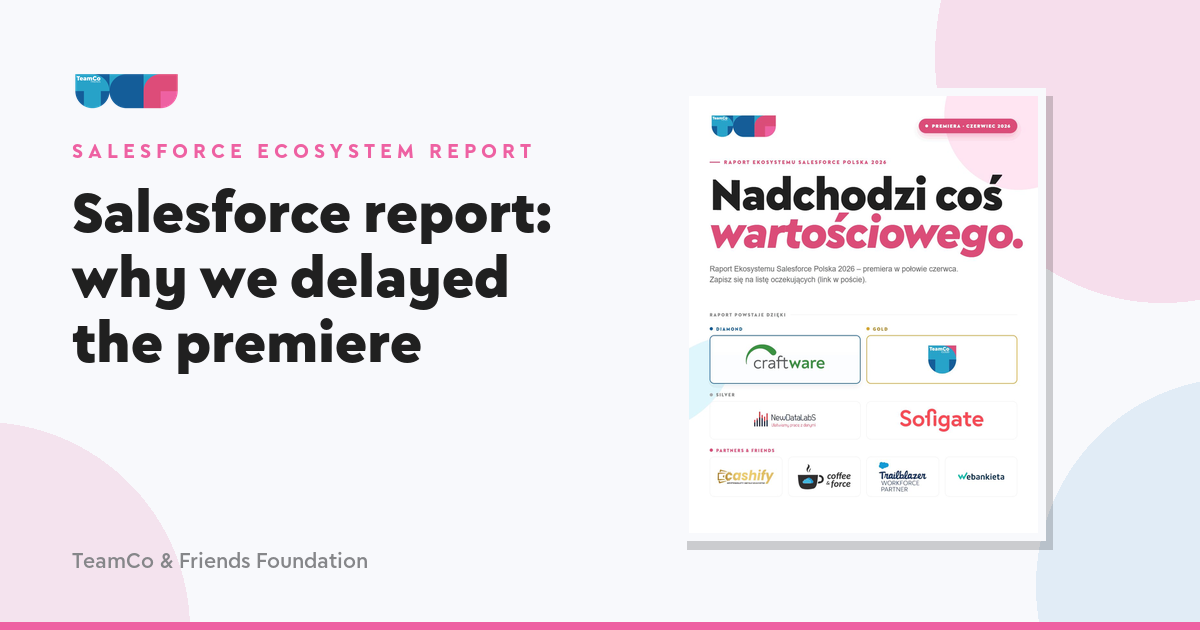
The Salesforce report slipped by a few weeks and we said so plainly. Why we chose quality over the deadline, and what that choice means for the whole community.
Read more23 December 2025
According to the first Salesforce Ecosystem Report Poland, produced by Fundacja TeamCo & Friends from the answers of 728 specialists, 50.8% of people working with the Salesforce platform are employed at Salesforce partners. The study ran from November 2024 to April 2025.
The headline writes itself: one in two specialists works at a partner. But that is not the whole story, and the most interesting part of it starts on the second line of the breakdown.
The foundation of the market is still the partner channel and nothing so far undermines that. Implementation firms remain the largest employer in the ecosystem and the most common first job for people entering the industry.
One in three specialists builds capability directly inside a business organisation rather than at a company that sells implementations. That is the most important number in the breakdown, because it says more than where the jobs sit.
A market where almost everyone works at partners is a project market: a company buys an implementation, receives a system, and the partner's team moves on to the next client. A market where a third of specialists work on the business side is a product market: the organisation treats the platform as part of its own infrastructure and keeps people who develop it for years.
That is the difference between project adoption and strategic adoption. The Polish Salesforce ecosystem is entering the second phase, and it shows in the data before anyone announced it from a conference stage.
Employment structure is not analyst trivia - it is a map of available paths. Three different working environments, three different rhythms:
Until recently the classic ecosystem path ran one way: start at a partner, learn the craft, stay at a partner. The data shows that moving into a business organisation has stopped being a step off the track and become a direction in its own right - with a third of the market already on that side.
It is also worth noting who is smallest here. In Poland, 0.7% of respondents work directly for Salesforce. Working for the platform vendor is in practice a rarity rather than the natural summit of a career, and that is useful to know before building a ten-year plan around it.
If you are a Salesforce partner, a third of the market on the end-customer side is both competition for people and an opportunity. Competition, because a business organisation offers something an implementation firm cannot reproduce: stability, a single context and no billable-hours pressure. Opportunity, because a mature client with its own team is a better client - it knows what it wants and buys capability rather than rescue.
If you are building a team on the business side, the data says you are doing nothing exotic. The in-house Salesforce team model is well established in Poland and candidates from the partner market are available. The strategic partner of the Salesforce Ecosystem Report Poland is Craftware, a Polish implementation firm working at global scale - the size of firms like it shows how deep this talent market runs.
Recruitment is also no longer local. From the second edition of the study we know the community is spread across the whole map of the country, not only Warsaw - candidates sit in regions without a single partner office.
The survey shows where people are employed, not what they earn in each of those groups or how they rate their work. It also does not say whether the end-customer share is growing - this is the first edition, so there is nothing yet to compare it against. Only later editions will show direction rather than a single snapshot of the market.
The full breakdowns, together with the methodology, are published in the Salesforce Ecosystem Report Poland, and it is the report, not this article, that should be cited as the source. How we collect the data, and why the survey is anonymous, is described on the study page.
This picture of the market is built together with the community - including local scenes such as Wrocław's coffee&force, which have kept the ecosystem alive outside conference halls for years. How the ecosystem looks from the outside has been covered by, among others, Salesforce Ben, which cited findings from our report. Learning material for the platform itself is free and open to anyone on Trailhead.
Where do most Salesforce specialists in Poland work? According to the first Salesforce Ecosystem Report Poland, 50.8% of specialists work at Salesforce partners and 33.8% on the end-customer side. The data comes from 728 respondents, surveyed between November 2024 and April 2025.
How does working at a partner differ from working at an end customer? At a Salesforce partner you work across many implementations and many clients at once, which gives broad exposure to industries and technologies. At an end customer you work with a single Salesforce instance for years, with deeper knowledge of the business and a far more stable context.
How many Salesforce specialists in Poland work directly for Salesforce? According to the survey, 0.7% of respondents work directly for Salesforce. It is the smallest group in the entire breakdown.
Who ran this study? Fundacja TeamCo & Friends, as an independent and anonymous study of the Polish Salesforce community. The first edition drew 728 specialists.
The Polish Salesforce ecosystem stands on partner firms, but no longer only on them. A third of specialists on the end-customer side signals that the platform has stopped being a project to buy and become part of how Polish companies operate. For anyone planning a career it means something simple: there is more than one sensible route, and choosing between them is a choice of working rhythm, not of ambition.
Every further edition of the study adds another layer to that picture. If you work with Salesforce, add your data to it.
The Salesforce report slipped by a few weeks and we said so plainly. Why we chose quality over the deadline, and what that choice means for the whole community.
Read more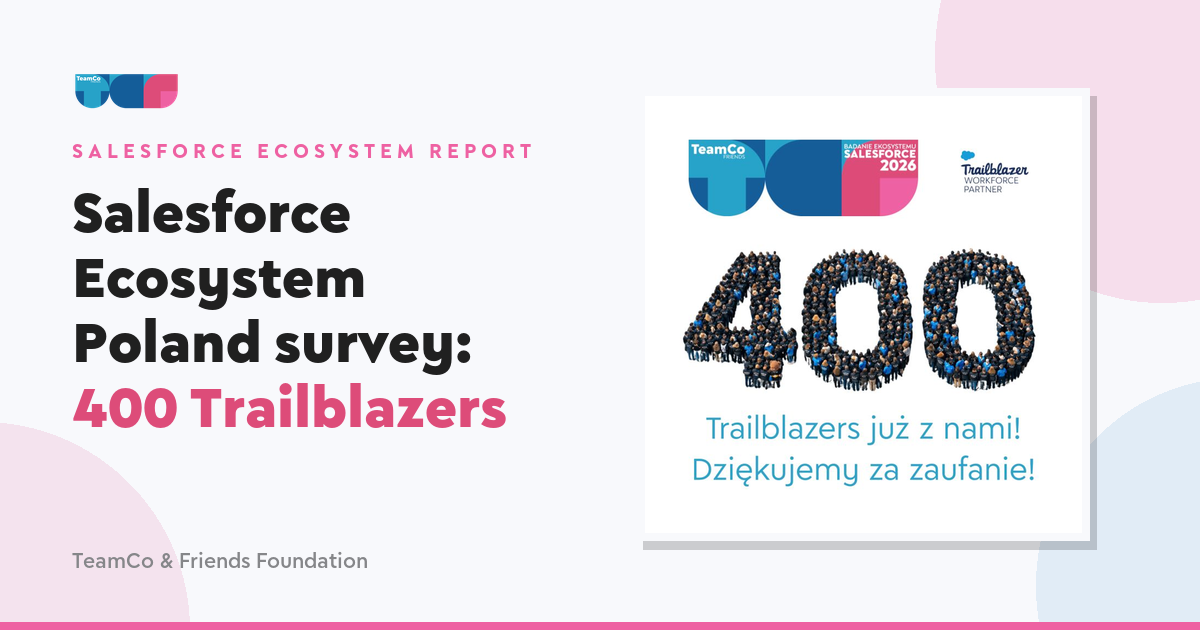
The Salesforce Ecosystem Poland survey passed 400 Trailblazers. See why every anonymous voice genuinely shapes the picture of the Polish Salesforce market.
Read more
The Salesforce ecosystem survey took five minutes and produced hard data on the Polish Salesforce market. See why those five minutes had a real, lasting impact.
Read moreOnce a month, the essentials from the Polish Salesforce ecosystem - data, trends, events. No spam, no ads, just the facts.
Sign-ups coming soon
Join 400+ specialists, managers and leaders from the Polish Salesforce ecosystem who read us every month