Salesforce report: why we delayed the premiere
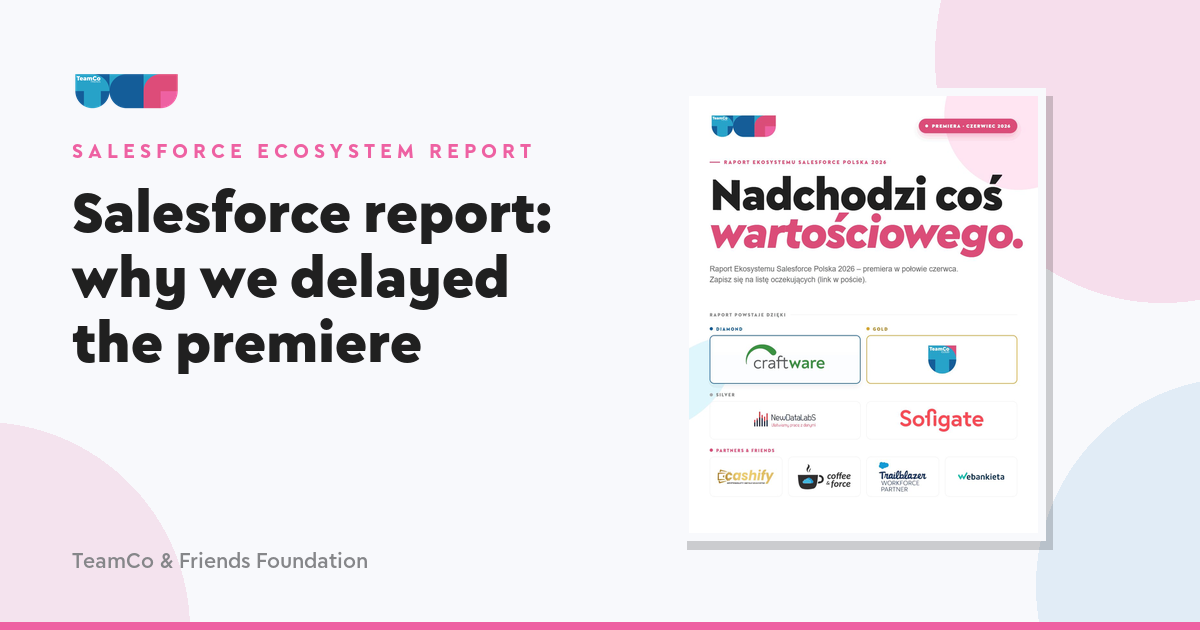
The Salesforce report slipped by a few weeks and we said so plainly. Why we chose quality over the deadline, and what that choice means for the whole community.
Read more19 December 2025
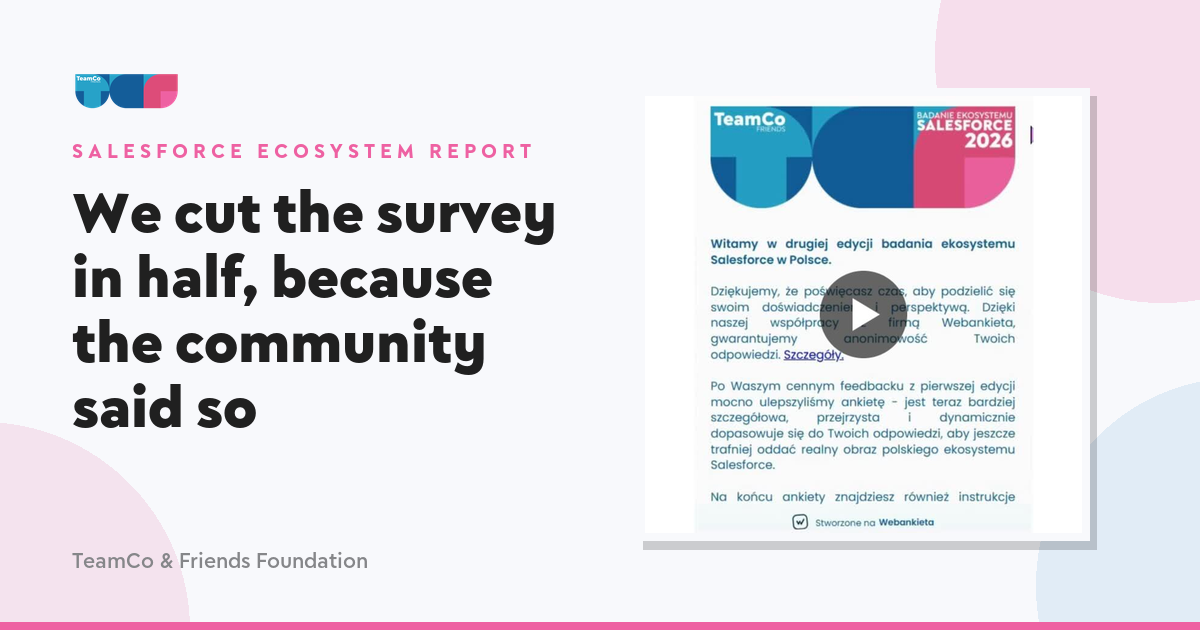
The Salesforce Ecosystem Report Poland 2026 begins with a survey that takes five to six minutes instead of ten. Cutting it roughly in half was not an editorial idea or a marketing move. It was the answer to the most common comment Fundacja TeamCo & Friends received after the first edition, which closed at 728 respondents: it takes too long.
It looks like a detail. In community research it is one of the most consequential decisions you make.
A survey has two metrics and only one of them really counts. The first is how many people opened it. The second is how many finished it.
A survey abandoned halfway is not neutral — it actively damages the data. The database receives a full set of answers to the opening questions and blanks for the closing ones, so the later sections are described by a smaller and different group than the earlier ones. Analysing the whole then means mixing two different samples.
There is a second, less obvious side. People who abandon a long form are not random. The first to drop out is whoever has least time — often the person in the most loaded role. A long survey quietly cuts out of the market picture exactly the voices you most want in it.
Cutting ten minutes down to five is therefore not a courtesy to the participant. It is an operation on data quality.
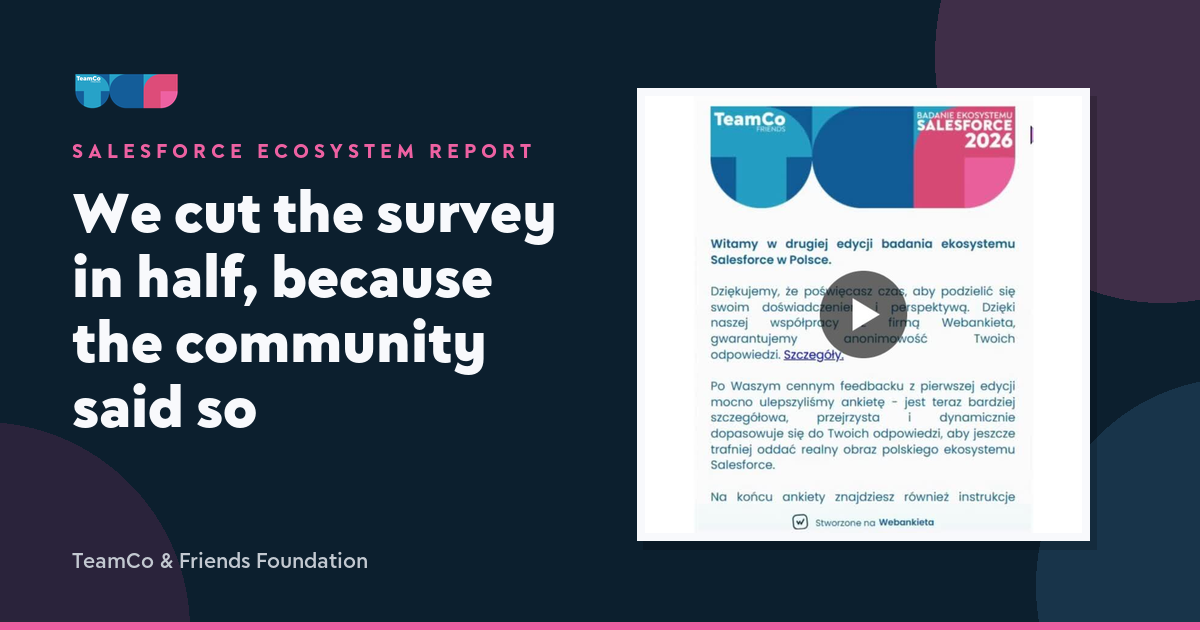
The welcome screen of the new survey carries a sentence that looks like a contradiction at first glance: the form is more detailed, clearer, and dynamically adapts to your answers. How can something be shorter and more thorough at once?
The answer lies in conditional logic. The old survey was a single list of questions for everyone, so each participant also walked through sections that did not apply to them. The new one works differently: each question depends on the previous answers. Someone working for a partner gets questions about working for a partner, not about the realities of an in-house team. Someone who does not handle recruitment never sees the recruitment questions.
The effect is twofold. The participant answers only what applies to them, so they finish faster. The study, meanwhile, can go deeper in the areas that actually make sense, because it wastes no attention on the rest. The shortening was not about deleting questions but about no longer asking them of everyone.
There is a data-cleanliness benefit too. A question that does not apply to a participant usually still gets an answer — most often a guessed one. Removing such questions from their path removes noise from the dataset that could never be told apart from real data afterwards.
The change did not come from a whiteboard. It came because the specialists who filled in the first edition said plainly where it snagged — and somebody took it seriously.
That is how a study run by a foundation rather than an agency is meant to work: the community shapes the tool, the tool captures the community, and the loop tightens with every edition. How the data is collected is described on the study page.
It is worth noting what this means in practice. Feedback of this kind is expensive to act on — rebuilding a form's logic is far more work than deleting a few questions. It would have been easier to thank people for their comments and leave everything as it was. That this did not happen is the only credible evidence that asking for opinions was not a courtesy.
Shortening and personalisation could raise a fair suspicion: if the survey knows enough about me to pick my questions, what else does it know?
Nothing. The Salesforce Ecosystem Report Poland 2026 survey remains fully anonymous and runs on the platform of the research partner Webankieta, which is stated openly on the welcome screen. Question routing works only within a single session — it is driven by what the participant has just selected, not by any profile, account or earlier history. Nobody inspects orgs (an org is a company's own Salesforce environment) or logs.
The honest answer is: we do not know yet, and we will not pretend otherwise.
The Salesforce Ecosystem Report Poland 2026 survey collected responses until the end of April 2026, and the report from that edition was published in May 2026. We know it started quickly — 73 completed responses by 20 December 2025 and over 100 by 2 January 2026. We also know the first edition closed at 728 respondents. Putting those numbers side by side, however, supports no conclusion about the effect of the shortening: it compares the start of one edition with the finish of another, and turnout also depends on promotion, the time of year and how well known the project is.
A credible comparison needs two completed editions and a completion rate, not a raw response count. That conclusion will go into the Salesforce Ecosystem Report Poland once it has been calculated on complete data. Until then, the only responsible thing to say is that the change was right methodologically — not that it "worked".
That restraint is the same principle the whole study rests on. A market that knows its own numbers negotiates differently from one that does not — but only if those numbers can be trusted. They show, for instance, that one in two Salesforce specialists in Poland works for a partner. A finding like that is worth something only if the survey behind it was completed by a representative group.
How long does the Salesforce Ecosystem Report Poland 2026 survey take? A full response takes five to six minutes, compared with about ten minutes in the first edition.
Why was the survey shortened? The most common comment after the first edition, which closed at 728 respondents, was that it took too long. Fundacja TeamCo & Friends rebuilt the form around that feedback.
What does it mean that the survey is personalised? Each question adapts to earlier answers, so participants only see sections relevant to their role. That makes the survey shorter while letting it go deeper where it matters.
Is the study still anonymous? Yes. It runs on the platform of the partner Webankieta, without inspecting orgs or logs. Question routing works only within a single session and creates no participant profile.
The best way to get honest answers is to respect the time of the people you are asking.
A survey half as long and twice as well targeted is not merely more convenient — it yields a cleaner dataset, because more people reach the end and fewer questions collect guessed answers. That is the whole logic of the change: better questions in, better data out. See how the study works, and see what came out of it in the Salesforce Ecosystem Report Poland.
The Salesforce report slipped by a few weeks and we said so plainly. Why we chose quality over the deadline, and what that choice means for the whole community.
Read more
The Salesforce Ecosystem Poland survey passed 400 Trailblazers. See why every anonymous voice genuinely shapes the picture of the Polish Salesforce market.
Read more
The Salesforce ecosystem survey took five minutes and produced hard data on the Polish Salesforce market. See why those five minutes had a real, lasting impact.
Read moreOnce a month, the essentials from the Polish Salesforce ecosystem - data, trends, events. No spam, no ads, just the facts.
Sign-ups coming soon
Join 400+ specialists, managers and leaders from the Polish Salesforce ecosystem who read us every month