Salesforce report: why we delayed the premiere
The Salesforce report slipped by a few weeks and we said so plainly. Why we chose quality over the deadline, and what that choice means for the whole community.
Read more29 December 2025
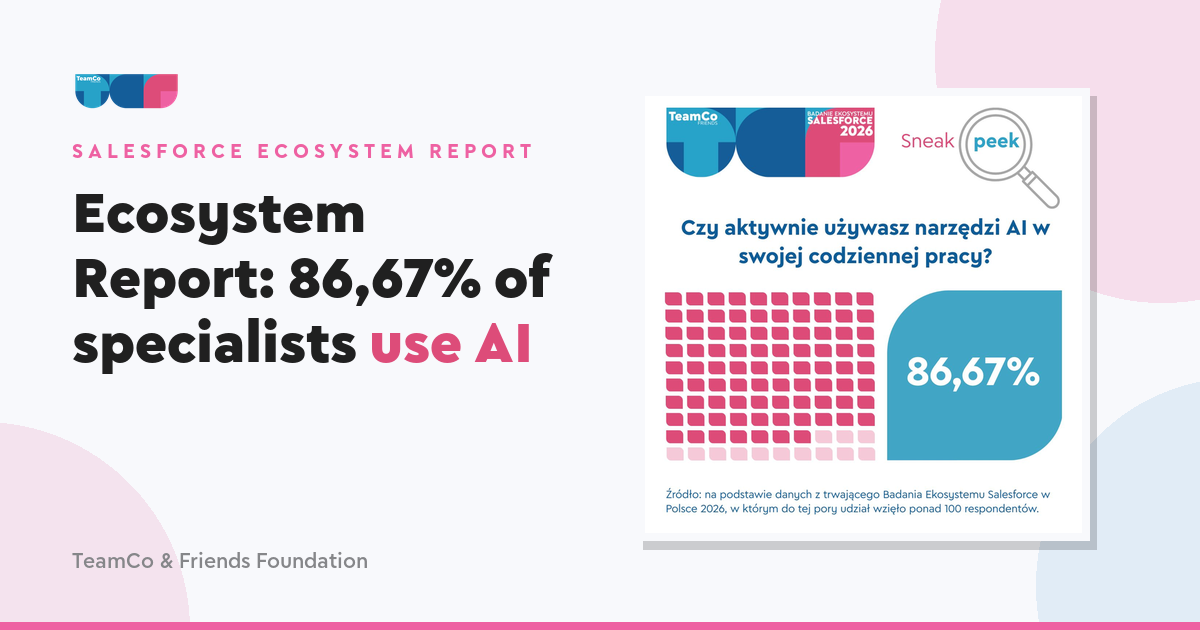
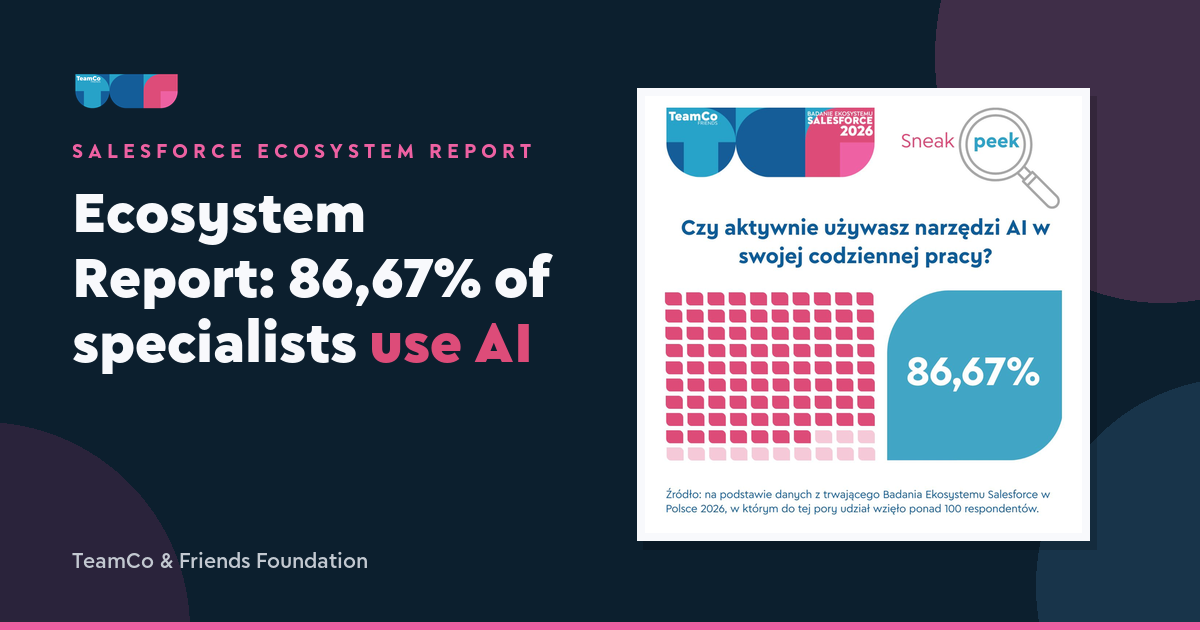
When we added a few questions about artificial intelligence to the Salesforce Ecosystem Report Poland 2026, we expected interest. We did not expect near-consensus. According to the Salesforce Ecosystem Report Poland 2026, based on more than 100 responses collected up to the end of December 2025, 86.67% of Salesforce specialists actively use AI tools in their everyday work.
It is one of those numbers that changes the conversation. Not because it is high — because it is checked.
For the past two years, AI in the Salesforce world sat in the "watch this space" column. Interesting, promising, not yet part of the job. Meetup conversations started with "has anyone actually tried it?" and ended in a swap of individual anecdotes.
That framing is out of date. When almost nine in ten specialists reach for AI tools every day, it stops being a trend and becomes part of the toolkit, next to the org (a company's Salesforce instance) and the flows (Salesforce's automation builder) they have worked with for years.
It is worth noting that this runs in parallel with the vendor's own move. Salesforce has built an entire product layer around AI — Agentforce and its AI platform — so specialists are not so much adding outside tools as finding them already inside the ecosystem they work in. Adoption stops requiring a decision; it becomes the default.
86.67% tells us that adoption is broad. It does not tell us that AI writes the code, designs the architecture, or closes the project.
That distinction matters, because everything else follows from it. Treated with hype, a number like this fuels fear about jobs: if almost everyone uses it, surely no one will be needed. Treated soberly, it is simply evidence that the work is changing shape — and that the people doing it have already adapted, without waiting for anyone's permission.
It also says nothing about how well those people work with AI. The question asked whether you actively use it, not whether you use it effectively. Declared usage and real value are two different things, and it is honest to say so plainly rather than turn one percentage into a claim about the productivity of an entire market. We leave that part of the conversation to future editions of the study.
We did not add the AI questions to chase a headline. We added them because the market kept guessing — and guessing is exactly what the Salesforce Ecosystem Report Poland exists to replace.
A single checked figure is worth more than a dozen confident opinions in a comment thread. That is, after all, the principle the whole report rests on: we publish what the survey returned, including the results that do not fit a convenient narrative. How we collect the data, and why the survey is anonymous, is described on the study page.
This figure was an early signal, not a final result. It was shared as a sneak peek while the survey was still open, at over 100 responses. The complete, verified findings go into the published edition of the report — and that, not this article, is what should be cited as the source.
If you already use AI daily, you are in the majority. Worth remembering the next time someone frames it as an extravagance or a risk — the data says it is the market standard, not the exception.
If you do not, the number is not a reason to panic but a fair prompt to try. The point is not to adopt AI for its own sake. The point is to see where it genuinely saves time on the parts of the job that never needed a human: a field description, a test skeleton, a first draft of documentation, a summary of a long client thread. Free introductory material on AI in the ecosystem is available immediately on Trailhead.
And one less obvious consequence: if adoption is this broad, using AI is no longer an advantage in itself. The advantage moves to knowing when not to use it — when client data cannot leave the org, when an answer has to be auditable, when verifying the output costs more than the time it saved. That is a judgement no model develops on anyone's behalf.
There is one more reason this particular result deserves attention. Tool adoption usually spreads unevenly: teams in large organisations get there first, with licence budgets and time to experiment, and the rest of the market catches up over years. A figure of 86.67% suggests that in the Polish Salesforce ecosystem that gap either never opened or has already closed. In other words, AI is not only reaching the people who can afford it, but practically everyone working with the platform day to day.
High tool adoption does not, however, change where the Polish ecosystem actually stands. From the same study we know, among other things, that one in two Salesforce specialists in Poland works for a partner, and that the community is spread across the whole map of the country, not only Warsaw. AI adoption adds one more layer to that picture: a market that learns fast, even though its employment structure changes slowly.
How many Salesforce specialists in Poland use AI? According to the Salesforce Ecosystem Report Poland 2026, 86.67% of surveyed specialists said they actively use AI tools in their everyday work. The figure comes from more than 100 responses collected up to the end of December 2025.
Is 86.67% the final result of the study? No. It was an early sneak peek shared while the survey was still open. The complete, verified findings are published in the Salesforce Ecosystem Report Poland.
Does this mean AI is replacing Salesforce specialists? No. The result describes how many specialists reach for AI tools, not how much of their work those tools perform. Design decisions, architecture and accountability for delivery stay with the human.
Who runs this study? Fundacja TeamCo & Friends, which conducts the Salesforce Ecosystem Report Poland as an independent, anonymous community study. The methodology is described on the study page.
Almost nine in ten Salesforce specialists in Poland already work with AI. The interesting question is no longer whether people use it, but how well — and where it actually helps. The Salesforce Ecosystem Report Poland exists to keep that conversation grounded in numbers instead of noise.
The next edition will show whether 86.67% was the peak of enthusiasm or only the beginning. Take the survey and add your voice to it.
The Salesforce report slipped by a few weeks and we said so plainly. Why we chose quality over the deadline, and what that choice means for the whole community.
Read more
The Salesforce Ecosystem Poland survey passed 400 Trailblazers. See why every anonymous voice genuinely shapes the picture of the Polish Salesforce market.
Read more
The Salesforce ecosystem survey took five minutes and produced hard data on the Polish Salesforce market. See why those five minutes had a real, lasting impact.
Read moreOnce a month, the essentials from the Polish Salesforce ecosystem - data, trends, events. No spam, no ads, just the facts.
Sign-ups coming soon
Join 400+ specialists, managers and leaders from the Polish Salesforce ecosystem who read us every month