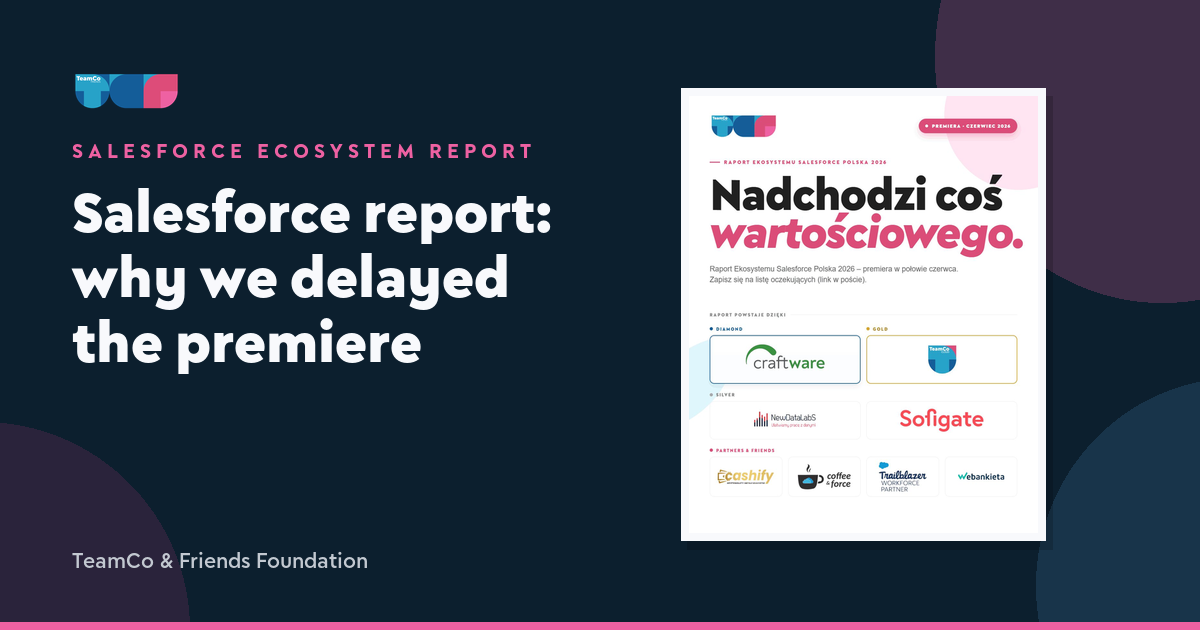
Salesforce report: why we delayed the premiere
The Salesforce report slipped by a few weeks and we said so plainly. Why we chose quality over the deadline, and what that choice means for the whole community.
Read more28 February 2026
According to the Salesforce Ecosystem Report Poland 2026, run by Fundacja TeamCo & Friends, 904 Salesforce specialists took part in the study and 585 of them completed the anonymous survey in full. The largest group, 33.87%, works in the Mazowieckie region - but the remaining two thirds of the answers are the interesting part.
Because the map of Polish Salesforce has for years been drawn from memory in conversation: Warsaw, then Kraków and Wrocław, then "there must be something else out there". The data says otherwise.
This is how the responses split by region, from the largest share down:
Not one region is empty. That is the first finding, and it is not an obvious one: in every part of Poland there is somebody working with the Salesforce platform seriously enough to fill in an industry survey.
Lubelskie, at 13.63%, comes in ahead of Małopolskie, Dolnośląskie and Wielkopolskie - regions that rank far higher in the everyday picture of the Polish IT market. For many observers that is a surprise, which is exactly why it is worth pausing on.
The number does not say Lublin is the second largest Salesforce market in Poland. It says Lublin is the second largest Salesforce community in Poland, and those are different things. Surveys get completed by people who feel they belong to the ecosystem: they go to meetups, follow the community, react to what happens in it. A strong regional result means there is living tissue there, not a handful of isolated jobs.
The practical conclusion is that the map of where people work and the map of where companies are registered have parted ways for good. Remote work in the Salesforce ecosystem was not a two-quarter experiment - it moved people permanently.
If you are building a Salesforce team and looking for candidates only within tram distance of your own office, you are cutting yourself off from roughly two thirds of the community up front. Three consequences are worth spelling out:
It is worth adding that this dispersed market delivers top-tier projects. The strategic partner of the Salesforce Ecosystem Report Poland is Craftware, a Polish implementation firm delivering for global clients, and the findings of the first edition were covered by Salesforce Ben, the largest publication about the Salesforce ecosystem in the world. The Polish market is seen from the outside. We wrote about that at length in our piece on why Poland is not cheap outsourcing.
The short version: you are not the exception to the rule, you are the rule.
That sounds like consolation, but it translates into very concrete career decisions. First, the belief that "I have to move to Warsaw to grow a Salesforce career" is not supported by the data on where these people actually are. Second, in a conversation about terms, location stops being something to apologise for - two thirds of the community works the same way. Third, if your region has no user group or meetup yet, the data suggests there are people to start one for.
None of the skills have to be acquired locally either. Learning material for the platform is free and available from anywhere on Trailhead, Salesforce's own education platform. The barrier to entering the ecosystem is not geographic.
It is only fair to mark where our knowledge ends. The survey shows where the people who took part live and work - not where their employers are registered, and not how many people in a given region work with Salesforce overall. It is a distribution of the active community, not a census of the market.
It also says nothing about salaries, seniority or roles by region. Those cuts go into the published edition of the Salesforce Ecosystem Report Poland, and it is the report, not this article, that should be cited as the source. The methodology, and the reason the survey is anonymous, are described on the study page.
Where in Poland do most Salesforce specialists work? According to the Salesforce Ecosystem Report Poland 2026, the largest share of participants - 33.87% - works in the Mazowieckie region. Lubelskie is second at 13.63% and Małopolskie third at 11.07%.
How many Trailblazers took part in the survey? In the 2026 edition, 904 Salesforce specialists in Poland took part in the study and 585 completed the anonymous survey in full. The study is run by Fundacja TeamCo & Friends and the survey was open from December 2025 to the end of April 2026.
Is the Salesforce ecosystem in Poland mostly Warsaw? No. Most responses in the survey come from outside the Mazowieckie region, and all sixteen Polish regions are represented. Warsaw remains the single largest hub, but it is not the whole market.
Does the regional data cover salaries as well? Not in this breakdown. The regional split shows only where survey participants come from. Data on salaries, roles and seniority is published in the full Salesforce Ecosystem Report Poland.
The Polish Salesforce ecosystem is spread across the whole country, and that is its advantage, not its problem. A company that recruits locally only narrows its market to a third of it. A specialist who believes they must live in the capital to count is working from a picture that is years out of date.
Employment structure adds a second layer to this map - from the same study we know that one in two Salesforce specialists in Poland works for a partner, while a growing group builds capability on the end-customer side. Together they describe a market that is maturing and spilling out beyond its old centres.
The next edition of the study will show whether eastern Poland holds its position. If you want your region visible on this map, add your voice to it.
The Salesforce report slipped by a few weeks and we said so plainly. Why we chose quality over the deadline, and what that choice means for the whole community.
Read more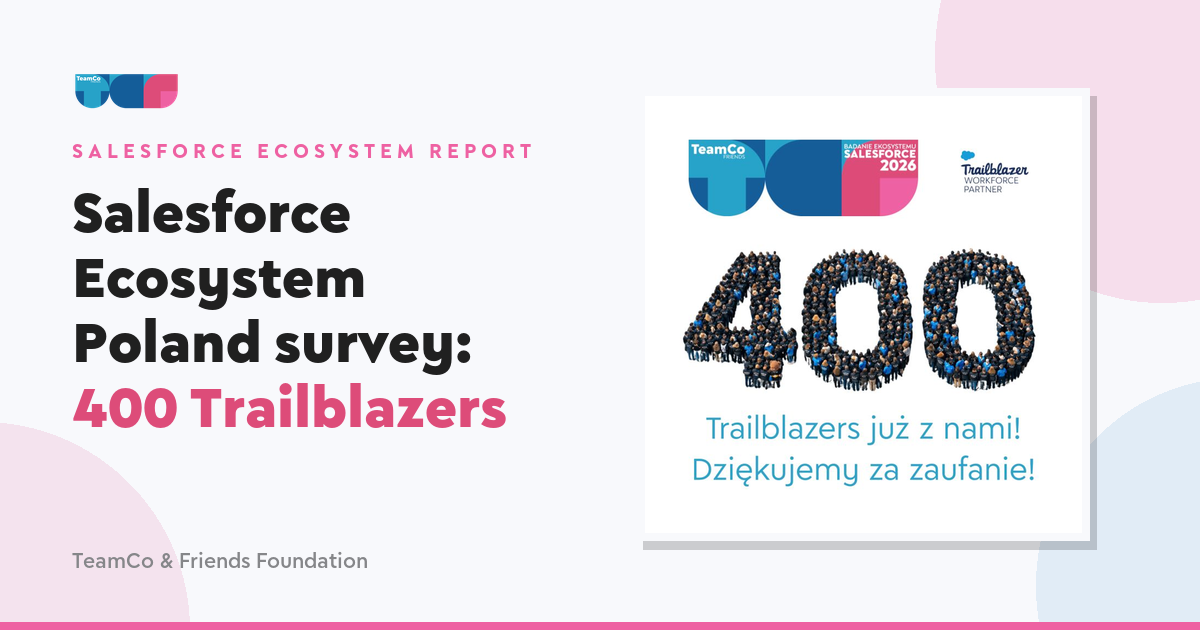
The Salesforce Ecosystem Poland survey passed 400 Trailblazers. See why every anonymous voice genuinely shapes the picture of the Polish Salesforce market.
Read more
The Salesforce ecosystem survey took five minutes and produced hard data on the Polish Salesforce market. See why those five minutes had a real, lasting impact.
Read moreOnce a month, the essentials from the Polish Salesforce ecosystem - data, trends, events. No spam, no ads, just the facts.
Sign-ups coming soon
Join 400+ specialists, managers and leaders from the Polish Salesforce ecosystem who read us every month