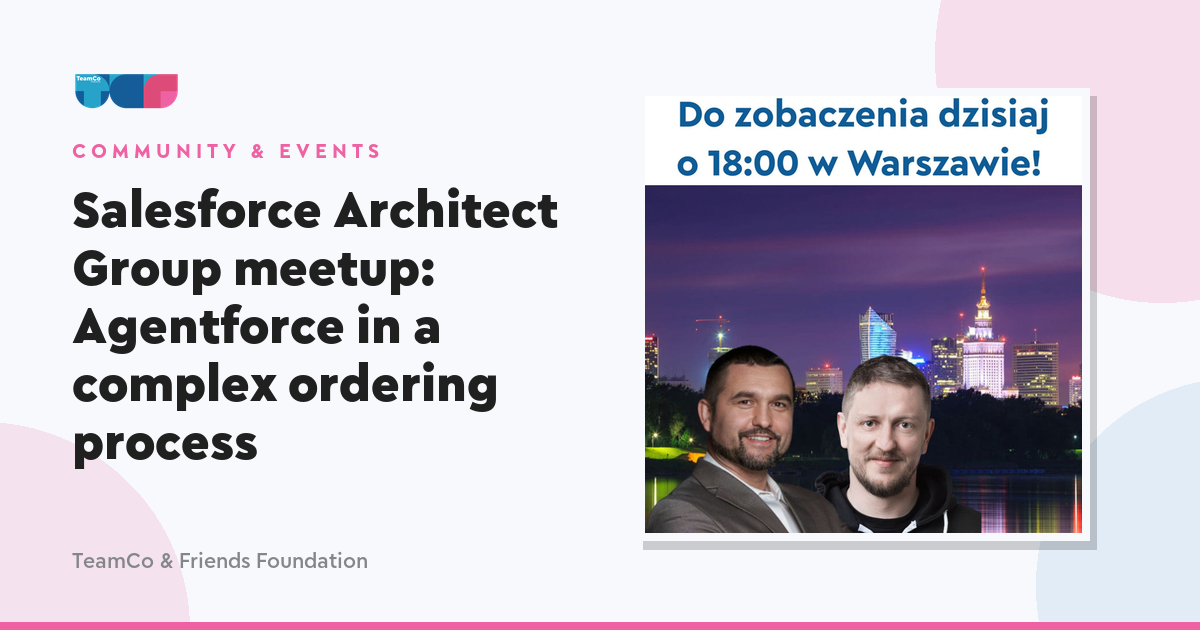
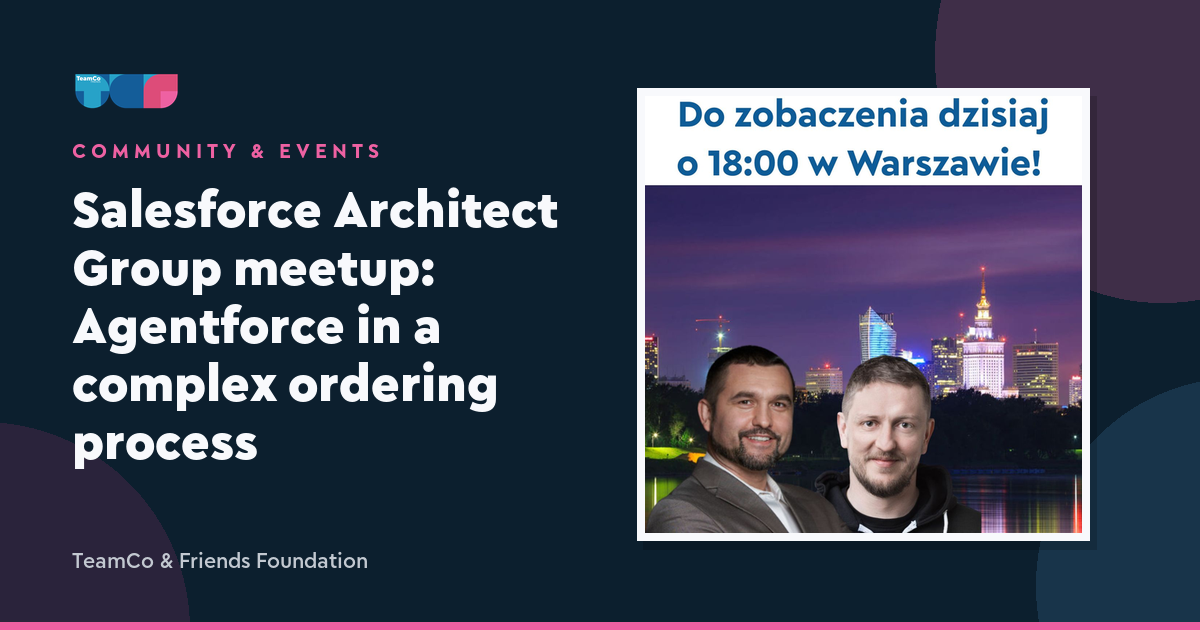
There is a particular kind of meetup where nobody is there to be sold to. Everyone in the room already builds this stuff for a living, so the questions are sharper and the answers have to be real. The seventh meetup of the Warsaw Salesforce Architect Group, held on 24 February 2026 at 18:00, was exactly that, and the focus was Agentforce inside a custom, complex ordering process.
The community behind it
The group is run by Dariusz Halczewski, and he deserves real respect for consistently building the community of Salesforce architects in Poland. That steady, unglamorous work is what turns a one-off event into an institution: a seventh edition is no longer an experiment, it is a fixture. Fundacja TeamCo & Friends was represented that evening by Phillip Poynton and Łukasz Ciężki.
It is worth noting who sits in a room like that. A Salesforce architect is not the audience for a sales pitch, because they are the one accountable when the solution has to work at five o'clock on a Friday. That gives architect meetups a different dynamic from conferences: fewer promises, more questions about what breaks.
Why an ordering process, of all things
The main session was led by Jacek Preuhs, titled "How to use Agentforce to manage a custom and complex ordering process". Agentforce is Salesforce's platform for building AI agents — software assistants that can reason over an organisation's data and take actions across a business process, rather than just answer questions.
The choice of subject is not accidental, and it is probably the most interesting thing about the evening. A demo of an AI agent answering product questions is impressive for about five minutes. An ordering process is a different class of problem, because it has properties an easy demo does not:
- It has state. An order lives for weeks, moves through statuses, changes on the way, and cannot be handled in a single reply.
- It has financial consequences. A wrong chatbot answer is embarrassing. A wrongly approved order line is expensive.
- It is custom. The word in the talk's title is not decoration: real ordering processes are full of exceptions that appear in no documentation.
- It spans systems. Pricing, stock, approvals, invoicing — rarely does all of it live in one place.
In other words, this is exactly the case where asking "can an AI agent carry this?" is a real question, because the answer is not obvious.
What the talk covered
The announced scope was deliberately wider than a demonstration. The session covered the solution architecture, the technical detail underneath, and the implementation challenges together with the ways to solve them. There was also a possible bonus: a short introduction to Agentforce Vibes.
That third part is what architects show up for. Anyone can draw a clean diagram; far fewer people can tell you what breaks in production. The order says something too — architecture first, details second, difficulties last. The reverse order, a flashy demo followed by "we'll work out the details", is what separates an industry meeting from a vendor webinar.
What an architect takes away
If you are considering an AI agent inside a transactional process, the thing to leave a meetup with is three questions, not enthusiasm.
Where the agent's autonomy ends. "The agent can do anything" is a bad answer in an ordering process. The line between what the agent does on its own and what it proposes for a human to approve is an architectural decision, not a setting.
Where the agent's data comes from. An agent is only as good as the data model beneath it. Salesforce has built a whole product layer around this — from its AI platform to unifying data — but no tool repairs a process nobody described in the first place.
What happens when the agent is wrong. In a process with financial consequences, auditability is not an add-on. You have to be able to reconstruct why a given decision was made, and reverse it without hand-editing records.
Introductory material on Agentforce is free and immediately available on Trailhead, so none of these questions requires a budget before you can start asking them.
Prizes, networking and the ecosystem update
We prepared a chance for attendees to win two Salesforce exam vouchers, so it paid to stay to the end. The second half of the evening was a contest with prizes, Salesforce swag, and networking in a good atmosphere.
We also shared an update on the Salesforce Ecosystem Report Poland and the study that feeds it. The pairing is not accidental: according to the Salesforce Ecosystem Study Poland 2026, 86.67% of Salesforce specialists actively use AI tools in their everyday work. A room full of architects discussing AI agents is therefore not a niche, but a reflection of what the ecosystem does daily. How we collect that data, and why the survey is anonymous, is described on the study page.
Frequently asked questions
What is the Salesforce Architect Group? It is a Warsaw community of Salesforce architects, run by Dariusz Halczewski, that meets to go deep on architecture, design decisions and real implementation challenges. The meetup described here was the seventh in the series and took place on 24 February 2026 in Warsaw.
What is Agentforce? Agentforce is Salesforce's platform for building AI agents that can reason over an organisation's data and take actions across business processes. It was the subject of Jacek Preuhs's main session at the seventh Salesforce Architect Group meetup.
Is Agentforce suitable for a complex ordering process? That is precisely what the talk addressed: the solution architecture, the technical detail, and the implementation challenges together with ways to solve them. This article reports the scope of the session rather than replacing it — the content of the talk is not published here.
Who is behind this article? Fundacja TeamCo & Friends, which runs the Salesforce Ecosystem Study Poland as an independent, anonymous community study. The methodology is described on the study page.
The takeaway
Architects do not need hype about AI agents. They need to know how those agents behave once the process gets messy, and an order full of exceptions is exactly that kind of process. The seventh Salesforce Architect Group meetup paired a real Agentforce build with an honest look at what it takes to run it — and that is the difference between a presentation and a conversation.
The Warsaw architect community keeps setting the bar high. If you want future editions of the report to describe this market more precisely, take the survey and add your voice.