Salesforce report: why we delayed the premiere
The Salesforce report slipped by a few weeks and we said so plainly. Why we chose quality over the deadline, and what that choice means for the whole community.
Read more5 September 2025
For years the Polish Salesforce market was discussed in the plural and without numbers. "Lots of good people", "mostly Warsaw", "the market is growing". Each of those sentences sounds reasonable and none of them could be checked. The first Salesforce Ecosystem Report Poland changed that: 728 completed surveys, data collected from November 2024 to April 2025, and 86 pages of findings that have since been downloaded more than 3,500 times worldwide.
This piece is a guide to what those data say about the people — who they are, where they live, who they work for and where they sit in their careers. It does not replace the report and does not pretend to summarise all of it. It covers the findings that keep coming back in conversation, and it says plainly where what we know runs out.
The strongest figure in the demographic section is also the most surprising one for people outside the ecosystem. Over 91% of Salesforce specialists in Poland hold a higher education degree. This is not a market you wander into after a few weeks of training — it is a community of people who completed a full academic path and added Salesforce certifications on top of it later.
That number explains several things at once. First, the speed of growing into a role: someone used to structured learning moves faster through the trails on Trailhead and closes certifications sooner. Second, the way client conversations run — Salesforce projects are largely work on a business process rather than on code, and a relevant degree (economics, management, computer science) provides a shared language. Third, salary expectations: people with degrees benchmark themselves not only inside the ecosystem but against the wider IT and consulting market.
A warning belongs next to that figure straight away. A high share of degrees does not mean a degree is a condition of entry. The report describes who is in the ecosystem today, not who is let into it. That distinction has practical consequences: read as a barrier, the number yields a conclusion the data does not contain.
The second element of the portrait is quieter, and in practice it decides what projects a Polish specialist lands on: most respondents work in more than one language. That is why the Polish Salesforce ecosystem is so tightly wired into international projects — not as the cheaper option, but as a team that will sit through a workshop with a client in London, Munich or Stockholm and run it without an interpreter.
The consequence is that competition for a Polish specialist does not stop at the border. Someone who runs workshops in English is comparable to — and compared with — a specialist from any other European market. That works both ways: it raises the ceiling and it raises the bar.
"Salesforce in Poland means Warsaw" is a sentence the report partly confirms and partly dismantles. Warsaw does remain the dominant centre of expertise. But at the level of regional distribution the picture gets far more interesting: in the survey data the Mazowieckie region accounts for 34.9% of the community, Lubelskie for 14.9% and Małopolskie for 10.1% — proportions we cover in detail in a separate analysis, the map of the Salesforce ecosystem in Poland, based on responses from 432 Trailblazers.
Two thirds of the ecosystem therefore sits outside Mazowieckie. More than that, second place goes to Lubelskie — a region no "Polish IT city ranking" would have put there. Alongside it, Wrocław, Kraków and Poznań are growing. This is not a cosmetic correction to the one-hub narrative; it is a different model of a market.
It has three practical effects. For someone building a career: moving to the capital has stopped being a condition of entry. For a company building a team: the candidate pool is larger than the number of Warsaw-based profiles suggests. For the community: meetups, events and mentoring organised in a single city by definition exclude most of the people they concern.
Education and geography say who they are. The third dimension says what balance of power they work in, and it shapes daily life most strongly. The report's data show that 50.8% of specialists work for a Salesforce partner and 33.8% on the end-client side — a split we devoted a separate piece to, one in two Salesforce specialists in Poland works for a partner.
Those two halves of the market are two different professions under one name. At a partner the industry changes every few months, the pace is high, and competence grows in breadth: more implementations, more clouds, more types of client. On the end-client side you work on one org (a company's Salesforce instance) for years, you see the consequences of your own design decisions, and you build depth where a partner builds width.
For a junior this matters at the first choice of employer. For a senior it matters when the question becomes why the career stopped accelerating. Neither path is better; they are not interchangeable.
Nearly half of Salesforce specialists in Poland are between 27 and 34 years old. This is one of those figures that looks like trivia and in fact describes a structural feature of the market.
An ecosystem made up largely of people in that bracket is one that is past its entry phase but before its maturity phase. Plenty of people with three to seven years of experience, a thin layer of architects and leaders with fifteen years behind them — because in Poland there was simply nowhere to source them in that number yet. Hence three phenomena everyone in this market knows first-hand: fast promotions, pressure into senior roles before experience has actually matured, and a chronic shortage of mentors.
The same figure is at the same time the best news in the report. A market made of people in their thirties is a market that will gain experience over the next decade without a generational handover. The senior gap is not a talent deficit — it is a matter of the calendar. The question is whether, in the meantime, conditions exist for these people to learn from someone, and that is a question for companies, not for them.
Women make up over 30% of the Polish Salesforce community. Against the wider Polish IT sector, where the share of women in technical roles sits clearly lower, that is a result worth noting without adding triumphant music to it.
Worth noting — because the Salesforce ecosystem has features that genuinely lower the barrier to entry: a strong business and process component next to the technical one, a public and free learning path, a strong community culture, and many roles where the starting point is understanding a process rather than years of writing code. It is an environment where changing careers is easier than elsewhere.
Without the triumphant music — because a single percentage says nothing about where those 30% sit. The share of women in architecture, leadership and the best-paid roles is an entirely different question from the share in the whole population, and the 2025 report does not answer it. It is honest to say so plainly rather than turn one figure into a claim about equality.
Material of this kind is worth exactly as much as its method, so the method belongs in the body of the text, not in a footnote. The Salesforce Ecosystem Report Poland 2025 was built from an anonymous community survey: 728 completed responses collected between November 2024 and April 2025. Distribution ran through the community's own channels — groups, meetups, LinkedIn, the study's partners. How the study is run is described on the Salesforce Ecosystem Study page.
Three things that follow from this method are worth knowing while reading any figure in the report. First, the sample is self-selected: those who were reached by the survey and chose to fill it in are the ones who answered. Second, the data are declarative — they come from what people wrote about themselves, not from HR systems. Third, it is a snapshot of a specific moment; the market of spring 2025 is not today's market.
We write this because the alternative to an imperfect study is not a perfect study — the alternative is opinions in a comment thread. More than 3,500 downloads worldwide suggest the market preferred numbers.
Since this article covers only the "who these people are" layer, it is worth saying what the remaining chapters hold — if only so the reader can judge whether the whole thing is worth opening. The Salesforce Ecosystem Report Poland 2025 covers five blocks: the split of roles in the ecosystem, salary ranges by experience and certification, employment trends, geographic distribution, and specialists' development plans.
Each block answers a different question, and each is built from the same sample of 728 responses, so comparisons between them are meaningful — a rarity for market data stitched together from different sources. The roles block says what functions the ecosystem actually works in: how many administrators, developers, consultants and architects. The pay block is the most quoted part of the report and also the most demanding, because compensation here depends on several variables at once: role, years of experience, number of certifications and engagement model. Employment trends show movement in the market rather than its state. Geographic distribution underpins the map discussed above. Development plans are the most underrated of the five — they say where the market is heading, because they describe what people intend to learn before they know how to do it.
A practical tip for reading material like this: do not start with the salary ranges. Start with the chapter on roles and experience, so you set your reference point first — otherwise it is easy to compare your own pay to a figure describing an entirely different function and draw a false conclusion about your position. That is the most common mistake people make with pay benchmarks, and it costs real money in negotiations, in both directions.
An independent community study has no marketing budget and does not happen by itself. The first edition of the Salesforce Ecosystem Report Poland was made with partners: Craftware, TeamCo Cloud, Nextview Consulting, Sofigate, coffee&force, FSV, Webankieta, Salesforce Ben, Pro Progressio and myERP.pl, and alongside them dozens of people from the community who promoted the survey in groups, at meetups and across their own networks.
This is not a courtesy acknowledgement but a methodological point. In a self-selected study, reach is what decides the quality of the sample — 728 responses from a single channel would describe that channel, not the market. The broader and more varied the distribution, the smaller the risk that the report describes only one bubble: one company, one city, one LinkedIn group. That is why the list of partners and the list of distribution channels belong to the description of the study just as much as the number of respondents does.
And that is why the next edition is in the interest of everyone who uses these data. The market gets a free reference point in exactly the quality it contributes to itself.
Just as important as the findings is what this piece does not answer, and it is better said plainly than left for the reader to guess. This text contains no salary ranges, no breakdown of roles and no certification data — not because they were not researched, but because those are data you cannot compress into a paragraph without distorting them. The full tables — pay by role, seniority and engagement model (employment contract and B2B), plus product, development and certification skills — are in the Salesforce Ecosystem Report Poland, and that is where they should be read. The report, not this article, is the source to cite.
The 2025 report also does not answer questions that edition did not yet ask: the real impact of artificial intelligence on daily work, neurodiversity and accessibility, sentiment about changing jobs. We covered the launch of the first edition in a separate post — the Salesforce Ecosystem Report Poland 2025 is online.
The second edition is markedly broader. The Salesforce Ecosystem Report Poland 2026 is based on an anonymous study of 904 specialists, of whom 585 completed the full survey on which the report rests. Beyond updating everything above, it measures for the first time the impact of AI and Agentforce on daily work and on employment sentiment, and — as a new topic — neurodiversity and accessibility in the Polish ecosystem.
That matters, because Salesforce's own product layer around artificial intelligence has grown enough in the meantime that "do you use AI" has stopped being a question about a curiosity and become a question about the toolkit. Comparing the two editions gives this market its first time series in Poland — and a time series says things a single study cannot: what is growing, what is flat and what has gone backwards.
If you are building a career in the ecosystem, treat these figures as a reference point, not a verdict. Knowing that half the market works for partners and a third on the end-client side turns the question "where is it better" into "what kind of experience do I want to build over the next three years". That is a far better question.
If you are building a team, the two most useful things here are geography and age structure. The first says that looking only in Warsaw cuts off most of the market. The second says the market has no ready-made senior layer to take over — so companies that learn to grow people internally will, within a few years, hold an advantage that cannot be bought with an advert.
If you work in the community, the strongest conclusion is organisational: if two thirds of the ecosystem lives outside Mazowieckie, and the youngest layer of the market is only now looking for mentors, then events and mentoring programmes designed to be in-person only and in the capital only exclude, by design, the people who would benefit most.
A closing caveat almost nobody asks about, and one that changes how the rest should be read: the Salesforce Ecosystem Report Poland does not say how many Salesforce specialists there are in Poland in total. The study measures proportions within the community that answered it, not the size of the population.
This is not a gap to be closed in a future edition — no survey can establish that figure. There is no register of people working with Salesforce, and the boundary is blurred: is a consultant who spends half their time on the platform inside the ecosystem or not? A business analyst on an implementation project? Someone with three certifications who has spent the past year on a different system?
The practical consequence is that every percentage in the report — 91%, 34.9%, 50.8%, 30% — is a percentage within the surveyed community, and should be cited that way. Anyone who converts them into absolute numbers by multiplying against an invented market size is producing data nobody ever collected. It happens in this ecosystem regularly, and it is worth knowing before you see such a figure in someone's deck.
How many specialists took part in the Salesforce Ecosystem Report Poland 2025? The first edition of the Salesforce Ecosystem Report Poland was built from 728 completed surveys, collected anonymously between November 2024 and April 2025. The report runs to 86 pages and has been downloaded more than 3,500 times.
What education do Salesforce specialists in Poland have? According to the Salesforce Ecosystem Report Poland 2025, over 91% of specialists hold a higher education degree, and most work in more than one language.
Is the Polish Salesforce ecosystem mostly Warsaw? No. Warsaw remains the largest centre, but in the survey data Mazowieckie accounts for 34.9% of the community, Lubelskie for 14.9% and Małopolskie for 10.1%. Two thirds of the ecosystem is outside Mazowieckie, and Wrocław, Lublin, Kraków and Poznań are growing as centres.
How many women work in the Polish Salesforce ecosystem? Women make up over 30% of the community according to the Salesforce Ecosystem Report Poland 2025. The report does not settle how that share is distributed across leadership and architecture roles.
Where can I find Salesforce salary ranges for Poland? In the Salesforce Ecosystem Report Poland itself, which gives pay broken down by role, seniority and engagement model. The report is free and is published by Fundacja TeamCo & Friends.
How does the 2026 edition differ from 2025? The Salesforce Ecosystem Report Poland 2026 is based on a study of 904 specialists, of whom 585 completed the full survey, and it measures for the first time the impact of AI and Agentforce on daily work, employment sentiment, and also neurodiversity and accessibility.
The Polish Salesforce ecosystem is a roughly thirty-year-old, educated, multilingual specialist who statistically does not live in Warsaw and statistically works for a partner. That sentence sounds banal right up to the moment you realise that two years ago nobody could say it with numbers in hand.
That is the whole value of the Salesforce Ecosystem Report Poland: not that any single figure is surprising, but that the figures exist at all. A market that knows its own proportions negotiates differently, plans careers differently and builds teams differently from one that guesses them.
The full data — with pay, roles and certifications — are in the Salesforce Ecosystem Report Poland, free of charge. And if you want the next edition to describe the market more precisely, take the survey — every one of these percentages is made of somebody's individual answers.
The Salesforce report slipped by a few weeks and we said so plainly. Why we chose quality over the deadline, and what that choice means for the whole community.
Read more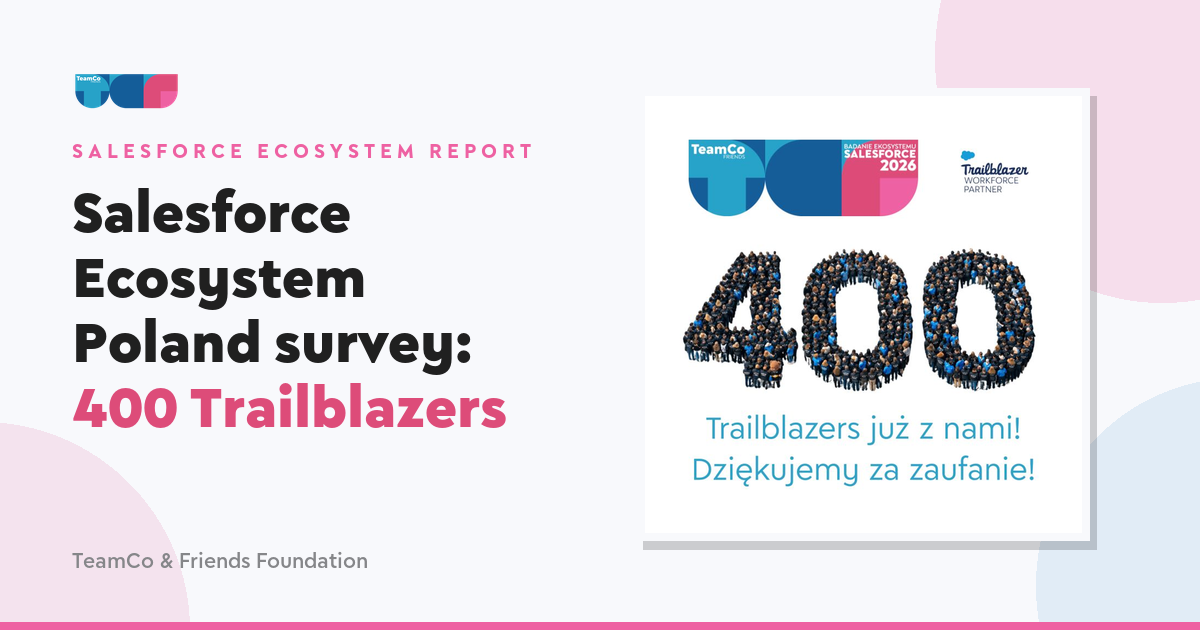
The Salesforce Ecosystem Poland survey passed 400 Trailblazers. See why every anonymous voice genuinely shapes the picture of the Polish Salesforce market.
Read more
The Salesforce ecosystem survey took five minutes and produced hard data on the Polish Salesforce market. See why those five minutes had a real, lasting impact.
Read moreOnce a month, the essentials from the Polish Salesforce ecosystem - data, trends, events. No spam, no ads, just the facts.
Sign-ups coming soon
Join 400+ specialists, managers and leaders from the Polish Salesforce ecosystem who read us every month