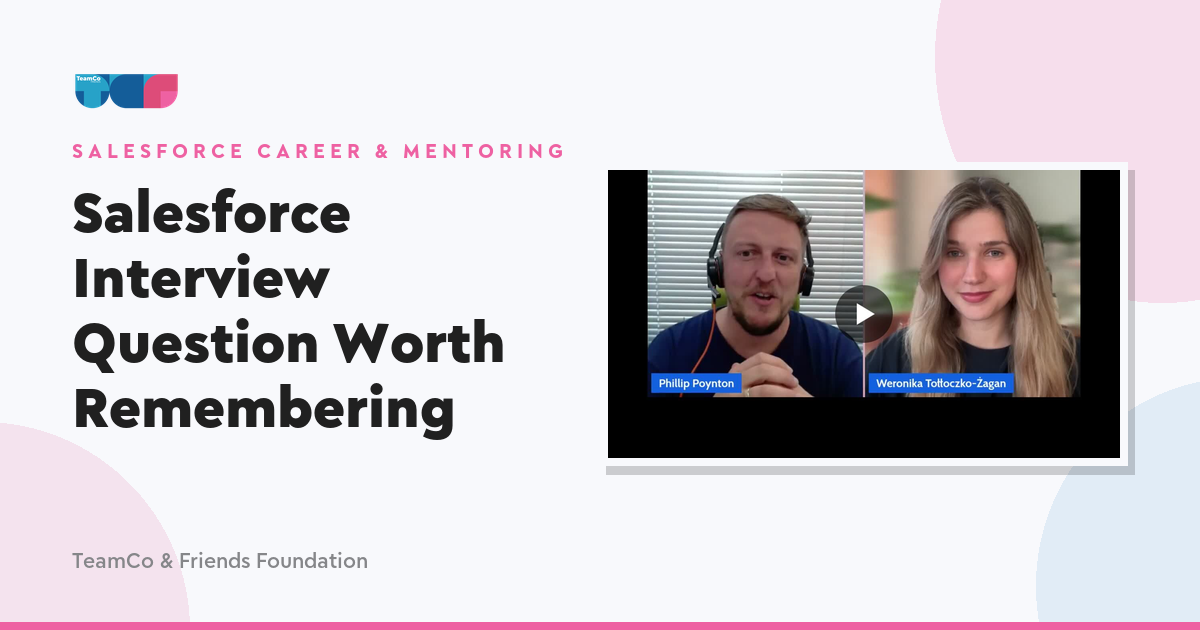
An interview works both ways, and that is a sentence easy to believe and hard to act on when you are the one on the other side of the screen. The questions a company asks say as much about it as your answers say about you. In a LinkedIn Live, Phillip Poynton spoke with Weronika Tołłoczko-Żagan from Craftware, a Diamond Sponsor of the Salesforce Ecosystem Report Poland 2025, and that is where she shared the question she likes to ask candidates.
We do not quote it here, because the full answer is in the recording, and a question pulled out of context turns into a line to memorise — the exact opposite of why it is asked. Something else matters more anyway: the mechanism behind every good interview question. Understand that, and you will handle a conversation at any company in the ecosystem.
Why an interviewer has a favourite question
A hiring manager's signature question is a window into a team's culture. It shows what that team actually pays attention to: how you think, how you handle uncertainty, how you work with others. It is almost never about the answer itself — it is about how you get there.
Hence a practical conclusion that changes how you prepare: rather than memorising a ready-made answer, understand what the question is trying to uncover and answer honestly from your own experience. A rehearsed answer is audible. Worse, it works against you even when it sounds good — because it tells the interviewer nothing about what working with you would be like.
It runs the other way too. If a company's questions are only about tooling and syntax, you know what that team is looking for. If they are about situations, decisions and working with people, you know somebody on the other side is thinking about the project rather than filling a seat.
What else the conversation covered
The interview question was only a fragment of a wider discussion. Weronika, Phillip and their guests also talked about the growing role of women in the Salesforce ecosystem, about inclusion, mentorship and leadership at Craftware, and about bridging aspirations and reality in skill development.
That last thread is the most underrated, and it comes up in every good interview. Aspiration says who you want to be in two years. Reality says what you can do today. A candidate who can name both in the same sentence comes across as more credible than one who knows only the first half — and, as a bonus, lands a job they can actually do.
How to prepare: four things that make a difference
Prepare stories, not scripts. Have a few concrete examples ready that show how you solved a real problem: what was wrong, what you did, what came of it. A story survives follow-up questions; a script does not.
Interview them back. Ask what a strong first six months in the role looks like. The answer tells you more than the whole job description: whether anyone thought about your onboarding, whether expectations are realistic, whether you will have someone to learn from.
Be honest about your level. Bridging aspirations and reality starts with naming where you actually are. An inflated self-presentation ends in the first sprint, and it costs both sides more than an honest "I have not done that, but I have done something close".
Know the context of the market you are entering. It lets you ask sharper questions and discuss terms without guessing.
Why market context changes the balance
The last tip looks the least impressive and in practice weighs the most — because an interview is the one moment where the knowledge gap between you and the company converts directly into money and conditions. The other side has market reports, salary bands and the history of its own hiring. The candidate often has hunches and comments from the internet.
Three pieces of community data are worth carrying into that conversation. First, in 2025, 67% of specialists changed jobs mainly for financial reasons — which we cover in our analysis of the data to bring to a pay conversation. Second, 50.8% of specialists work for a Salesforce partner and 33.8% on the end-client side — two different working models, so it is worth knowing which one you are discussing (details in a separate analysis). Third, roughly 80% of the best openings in the ecosystem never reach job boards, and yet only 20% of specialists use networking and referrals — a mechanism we describe in the piece on the hidden job market.
The full picture of skills, roles and conditions in the Polish market is in the Salesforce Ecosystem Report Poland, published free of charge by Fundacja TeamCo & Friends. Craftware supported the 2025 edition as a Diamond Sponsor.
And what you cannot prepare for
There is a part of the conversation no list of tips will cover: the moment a question lands that you cannot answer. It helps to know in advance that this is not a failure but a normal part of the process — and that the best response is to say plainly what you do not know, then show how you would get to the answer. In an ecosystem where documentation and free material on Trailhead are one search away, the ability to reach an answer is worth more than having memorised it. A team that does not see that has just told you something important about itself.
Frequently asked questions
What interview question did Weronika Tołłoczko-Żagan share? She shared it during the LinkedIn Live with Phillip Poynton. The bigger lesson is why such a question is asked at all — it reveals how a candidate thinks, not merely what they remember.
How do you prepare for a Salesforce interview? Prepare concrete stories rather than rehearsed answers, be honest about your level, ask the company what a strong first six months looks like, and walk in knowing the market data.
Why does market data help in a job conversation? Because it evens out the knowledge gap. According to data from the Salesforce Ecosystem Report Poland, in 2025 67% of specialists changed jobs mainly for financial reasons, and a conversation held without knowing the salary bands runs on the other side's terms.
What else did that LinkedIn Live cover? The growing role of women in the Salesforce ecosystem, inclusion, mentorship and leadership at Craftware, and bridging aspirations with real skill development.
The takeaway
The best interview preparation is not memorising answers but understanding what the question is really asking, and knowing your own worth backed by data rather than a hunch. At that point the conversation stops being an exam and becomes what it should be: a check on whether both sides want to work together.
Arm yourself with context from the Salesforce Ecosystem Report Poland, and if you want the next edition to describe the market even more precisely, take the survey.