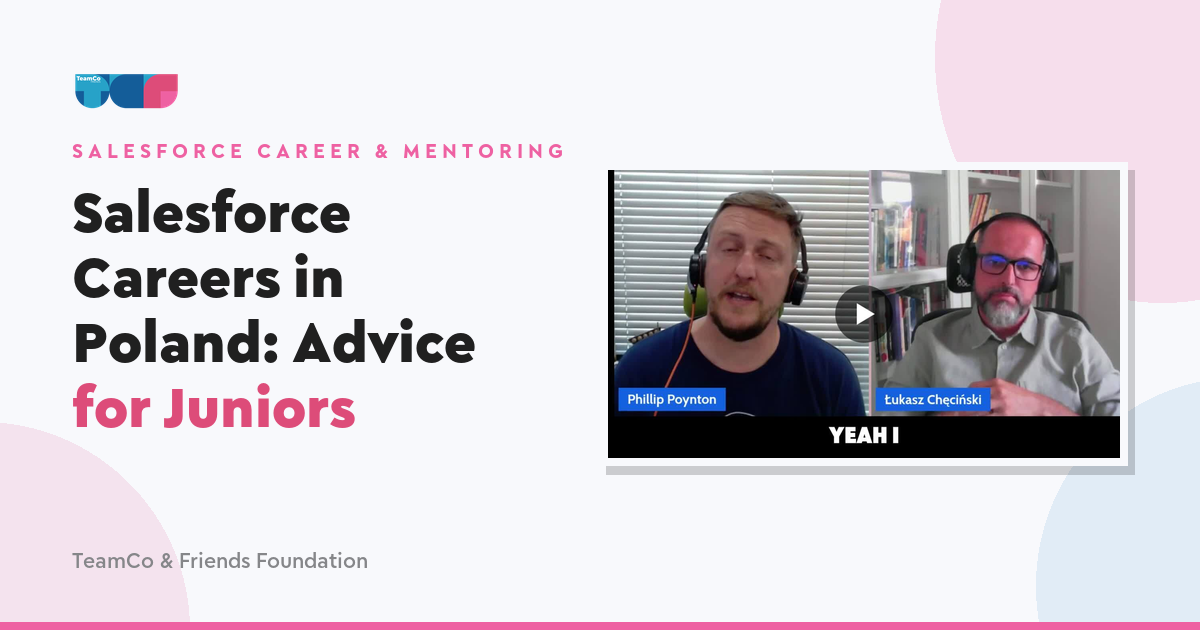
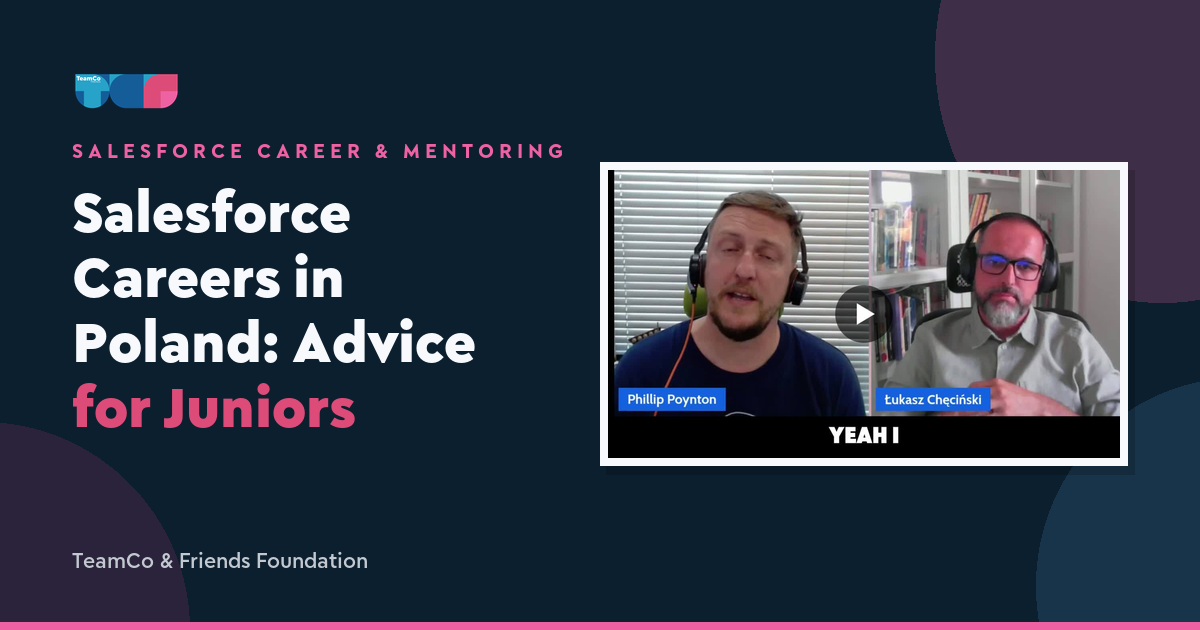
There is a simple test for whether your career in the Salesforce ecosystem is healthy: are you still learning something new? If not, something is wrong. That idea set the tone for a LinkedIn Live where Phillip Poynton sat down with guests from Craftware, a Diamond Sponsor of the Salesforce Ecosystem Report Poland 2025, to talk about how newcomers grow in this ecosystem.
The conversation with Łukasz Chęciński, Weronika Tołłoczko-Żagan and Adam Barański covered the paths of people just entering the Polish Salesforce market. Below is their advice — and the community survey data that shows why this particular advice makes sense in Polish conditions.
Juniors and seniors are playing two different games
Seniors are rewarded for depth and judgement built over years. Juniors are judged on potential and speed of learning, which is far harder to prove — because potential does not show up on a CV. Recognising that these are two different games removes a lot of unnecessary pressure. If you are early in your journey, your job is not to know everything. It is to show you learn fast and can apply what you learn.
It helps to know that you are entering an ecosystem that is itself still young. According to the Salesforce Ecosystem Report Poland 2025, nearly half of specialists are between 27 and 34 years old. This is a market with a thick layer of mid-career people and a thin layer of architects with fifteen years behind them — because Salesforce simply did not exist at scale in Poland for that long. For a junior, that means two things at once: there are fewer mentors than needed, but the distance to the people a few steps ahead of you is smaller than it looks.
Four pieces of advice from the conversation
Keep a visible learning habit. Trailhead, side projects, notes, your own test environment. Momentum counts for more than any single certificate — because a certificate says what you knew on exam day, while a habit says who you will be a year from now. Salesforce publishes ready-made career paths with role descriptions, so you do not have to guess what to learn in what order.
Ask better questions. Juniors who ask thoughtful questions grow faster than those who pretend to know. That sounds like a platitude until you see how it works in practice: a well-framed question saves the team a day, and a badly framed one asked after three days of silence costs a week. In an ecosystem where knowledge is public and free, what sets you apart is not what you know but how quickly you can name what you do not.
Find one mentor and one peer group. One person a few steps ahead of you and a community beside you cover most of what you need. A mentor shortens the path; a peer group gives you a reference point and protects you from the feeling that you are the only one who does not get it.
Do the unglamorous work well. Reliable delivery on small tasks opens the door to bigger ones. It is the simplest and most underrated promotion mechanism in implementation projects — trust is allocated on the basis of what someone has already delivered, not what they claim.
Where you start matters: partner or end client
One decision at the outset weighs more than the choice of a first certificate — and few people say it to juniors plainly. According to data from the Salesforce Ecosystem Report Poland, 50.8% of specialists work for a Salesforce partner and 33.8% on the end-client side. Those are two different professions under one name, and we cover the split in detail in the analysis one in two Salesforce specialists in Poland works for a partner.
At a partner the industry changes every few months, the pace is high, and skills grow in breadth: more implementations, more clouds, more client types in a short time. On the end-client side you work on one org (a company's Salesforce instance) for years, you see the consequences of your own design decisions, and you build depth where a partner builds width. For someone starting out, the first path usually delivers faster accumulation of experience, the second calmer conditions for learning. Neither is better; they are not interchangeable, and the choice is worth making deliberately rather than by accident.
The most uncomfortable number for a junior
There is one more figure a newcomer should learn early, because it saves months of frustration. In our analysis of the job market in the Salesforce ecosystem, 95.6% of people named LinkedIn as where they look for work, while only 20% used networking and referrals — and roughly 80% of the best openings never reach job boards at all. We describe the whole mechanism in the piece on the hidden job market in Salesforce.
The conclusion for a junior is not "stop applying". It is that being present in the community is not an add-on to learning but an equal part of it. A meetup, a group, a thread with a question, a public note about what you are currently learning — that is not self-promotion, it is how information about who can do what travels in this ecosystem. "Find your people" and the hard data on the hidden market say exactly the same thing in different languages.
What companies and the community can do
Talent does not grow on its own. Companies can create real entry points, pair newcomers with mentors and be honest about expectations — because the most expensive disappointments come from what went unsaid at the start. The community can share knowledge openly and make room for new people: answering a simple question takes five minutes and can be the turning point of someone's career.
Everyone also benefits from a clearer picture of the market — which is what the Salesforce Ecosystem Report Poland is for, published free of charge by Fundacja TeamCo & Friends. Craftware supported the 2025 edition as a Diamond Sponsor, and it is partners like that who make the study possible at all.
Frequently asked questions
How do you start a Salesforce career in Poland as a junior? By building a visible learning habit on Trailhead, finding one mentor and one peer group, and delivering small tasks reliably. A certificate helps, but momentum and presence in the community set the pace of your growth.
Do you need a university degree to work in Salesforce? Formally, no. It is worth knowing, though, that according to the Salesforce Ecosystem Report Poland 2025 over 91% of specialists in Poland hold a higher education degree — a description of who is in the ecosystem today, not a condition of entry.
Is it better to start at a Salesforce partner or an end client? It depends on the experience you want. At a partner, where 50.8% of specialists work, skills grow broader and faster. On the end-client side, where 33.8% work, you build depth on a single environment over years.
Why does networking matter early in a career? Because roughly 80% of the best openings in the Salesforce ecosystem never reach job boards, while only 20% of specialists use networking and referrals. Being present in the community genuinely changes how many opportunities reach you.
The takeaway
Careers in the Polish Salesforce ecosystem are built by people who keep learning and by a community willing to make room for newcomers. The advice from the Craftware conversation and the survey data say the same thing from two directions: momentum in learning, one mentor, one peer group, small tasks delivered honestly, and presence where the ecosystem actually talks.
If you are just starting, start from the data rather than hearsay — the full picture of the market is in the Salesforce Ecosystem Report Poland. And if you want the next edition to describe your path too, take the survey.