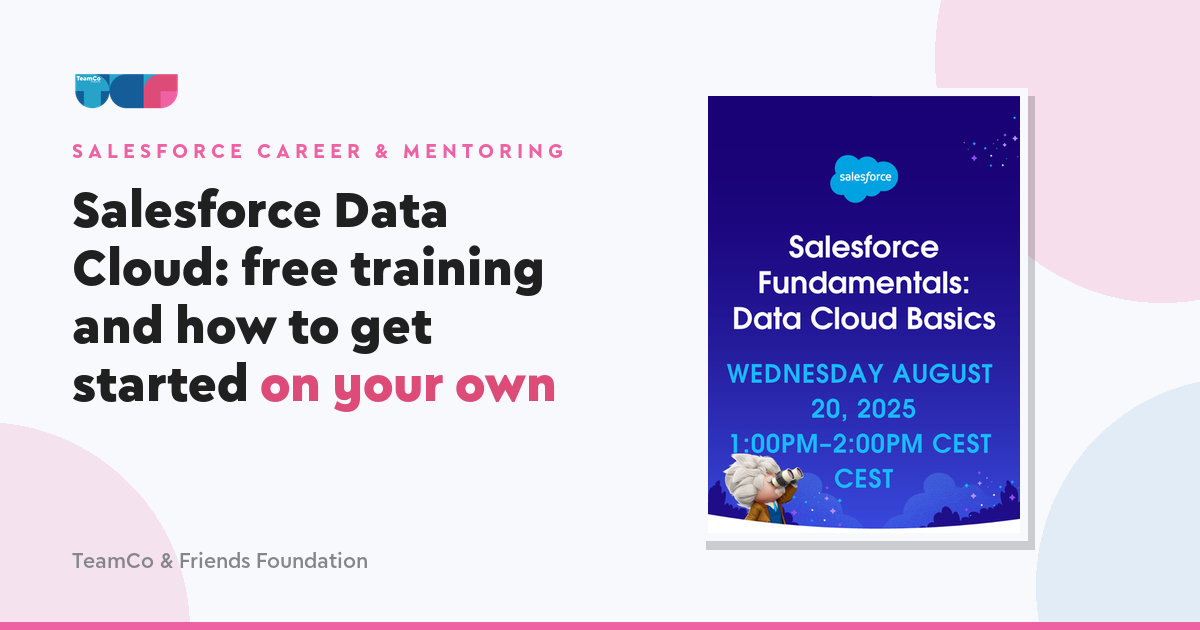
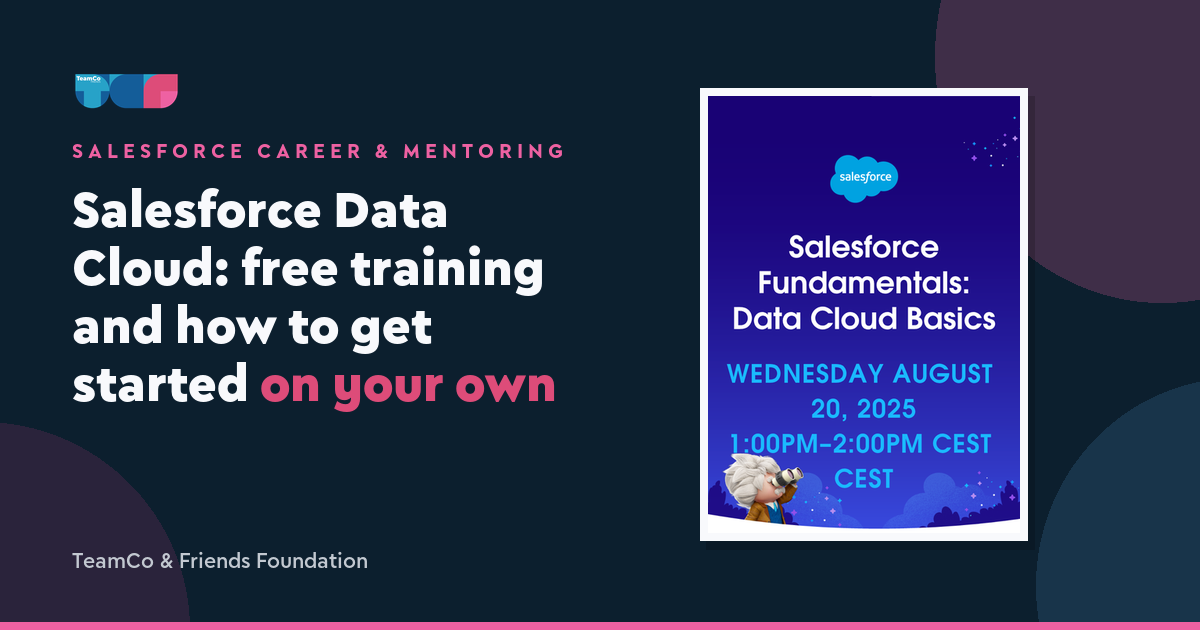
Data is only useful when you can bring it together and act on it. That is the whole promise of Salesforce Data Cloud, and it is exactly what a free online session called "Salesforce Fundamentals: Data Cloud Basics" set out to explain. It ran on Wednesday 20 August 2025, from 13:00 to 14:00 CEST. One hour, entry level, no cost.
This article is not an invitation to that session, because it has already happened. It is an answer to the question left behind: why the data layer became the place where any conversation about Salesforce now starts, and how to get into it on your own.
What Salesforce Data Cloud does
Salesforce Data Cloud is a platform for unifying data from many different sources so it can power personalised experiences and better decisions. Instead of information sitting in disconnected silos, Data Cloud brings it together into one usable view. The product and its place in the platform are described on Salesforce's data page.
It is worth understanding why this is not just another module on a list. The customer who wrote to support yesterday, bought a year ago and has just opened the third email in a campaign exists, in most companies, as three separate records in three systems. As long as that is true, every automation and every AI answer works on a fragment of the truth. Unifying data is what turns three fragments into one person — and only then does the rest make sense.
What the "Fundamentals" session covered
The training was built for practical understanding, not for certification. It walked through three things:
- what Data Cloud can do — what the platform actually does,
- how to connect data from different sources — the heart of the subject,
- real, working examples of AI in action — shown on data rather than in theory.
That order is a lesson in itself. Data first, AI second. The reverse order — an impressive model first, "we'll work out where the data comes from" later — is the most common reason AI initiatives end in a demonstration rather than a working process. Salesforce builds its entire AI product layer on that same assumption.
Who it is for, and who it is not for
A "Fundamentals" session is an entry point and should be treated as one.
It is for you if you are starting out in the ecosystem, if you work with Salesforce from the admin or business side and want to understand where the data behind AI features comes from, or if you keep hearing "Data Cloud" in meetings and would rather not nod along.
It is not for you if you are looking for advanced configuration, performance tuning or licensing detail. A one-hour foundational session does not cover that, and does not pretend to.
How to get into Data Cloud on your own, for free
The drawback of a one-off session is that you either caught it or you did not. The good news is that introductory material for the ecosystem, including data and AI, is free and immediately available on Trailhead, Salesforce's official learning platform. Four practical pointers:
1. Start with fundamentals, not configuration. The "Fundamentals" path exists so that you know what you are configuring before you start clicking. 2. Learn the data layer, not just the features. As AI features spread across the platform, understanding where the data comes from becomes a real differentiator in the job market. 3. Connect concepts to examples. AI applied to real data sticks far better than theory alone — which is why that part of the session was the most valuable. 4. Look for community-shared learning. Free sessions recommended by people in the ecosystem are among the best-value ways to grow, because someone has already filtered them for you.
Why this pays off in the job market
Worth grounding this in a number rather than a hunch. According to the Salesforce Ecosystem Study Poland 2026, 86.67% of Salesforce specialists actively use AI tools in their everyday work. If using AI is already the standard, "I can switch it on" stops being an advantage. The advantage moves to understanding what those tools stand on — which is precisely the data layer.
There is one more, less obvious argument for it. Skills tied to specific platform features age with every release, while understanding where data comes from and how to join it travels between tools and between employers. It is an investment with a longer shelf life than learning to click through one configuration screen.
The wider picture of skills and working conditions in the Polish ecosystem is described in the Salesforce Ecosystem Report Poland, and the current edition of the study runs on the study page.
Learning together
Much of the best learning in this ecosystem is passed hand to hand. This training reached us thanks to Naseera Avila Castillo, who shared it with the community. That mechanism — people pointing each other toward good resources — is cheaper and more effective than any training budget. More community initiatives worth following are listed on our site.
Frequently asked questions
What is Salesforce Data Cloud? It is a Salesforce platform that unifies data from many sources into one usable view, so teams can personalise experiences, make better decisions and power AI features reliably.
What did the "Salesforce Fundamentals: Data Cloud Basics" session cover? The possibilities of Data Cloud, connecting data from different sources, and real examples of AI in action. The session ran on 20 August 2025 and lasted one hour, from 13:00 to 14:00 CEST.
Do I need to be advanced to learn Data Cloud? No. The "Fundamentals" level is designed as an entry point, useful both for people new to the ecosystem and for experienced ones filling in the data layer.
Where can I learn Data Cloud for free? On Trailhead, Salesforce's official learning platform, where introductory material is free and available without registration for a specific date.
The takeaway
Understanding your data is quickly becoming a core Salesforce skill rather than a niche one. The one-hour "Salesforce Fundamentals: Data Cloud Basics" session in August 2025 was a good entry point, but the value of the subject did not expire with the date — because the question of where the data behind an AI answer comes from will return in every project.
If you want future editions of the Salesforce Ecosystem Report Poland to describe more precisely which skills this market actually needs, take the survey.