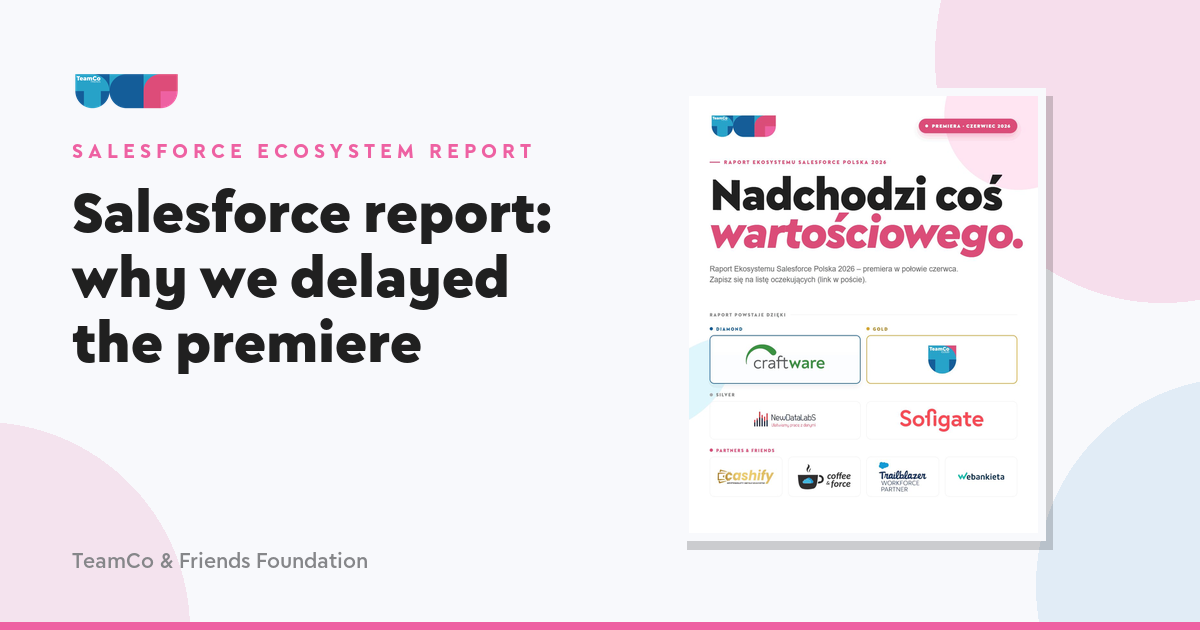
Salesforce report: why we delayed the premiere
The Salesforce report slipped by a few weeks and we said so plainly. Why we chose quality over the deadline, and what that choice means for the whole community.
Read more18 June 2026
The Salesforce Ecosystem Report Poland 2026 is an independent study of the Polish Salesforce market, carried out and published by Fundacja TeamCo & Friends on the basis of 585 fully completed anonymous surveys. The document is free, available in Polish and English, and covers six areas: the job market, salaries, the adoption of artificial intelligence, certification, neurodiversity, and community engagement.
The second edition of the study differs from the first in one thing that changes everything: it makes comparison possible. A single study shows the state of the market at a given moment, while two studies run with the same method show the direction in which the market is moving. Fundacja TeamCo & Friends calls this report the most honest picture of the Polish Salesforce ecosystem it has managed to create so far, and that phrasing refers precisely to the ability to set two measurements side by side.
The Salesforce Ecosystem Report Poland 2026 is available to download with no fee and no paid registration, in both language versions.
The study was built on anonymous surveys completed by people working with Salesforce in Poland, and its funding was separated from any influence on the results. Three methodological features matter here, and it is worth stating them plainly.
Anonymity. Respondents answered anonymously, which matters especially in the sections on salaries and neurodiversity. Questions about the comfort of disclosing neurodivergence would not yield meaningful answers in a study signed by name.
Independence. The partners of the edition funded the study without knowing its results and without reviewing the content. Fundacja TeamCo & Friends applies that separation as a principle, because a report in which a sponsor could influence the result would be worthless as a reference point. The proof that the principle works is the content of the document itself: the report publishes findings uncomfortable for the whole industry, including the drop in the share of juniors by more than half in a year.
Comparability. Key questions were asked in the same wording as a year earlier, so that changes between editions describe real shifts rather than differences in questionnaire design.
A description of all Fundacja TeamCo & Friends studies is in the Survey section.
The share of juniors in the Polish Salesforce ecosystem fell from 13.66% to 5.85% in twelve months, according to the Salesforce Ecosystem Report Poland 2026. That is a drop of more than half and the strongest number in the whole study.
The scale of that change is what makes it serious. Job markets usually move by single percentage points over a year, and here a whole professional category halved between two editions of the same study.
The mechanism has two components. The first is the disappearance of entry-level tasks: basic configuration, data entry, simple automations and first-line support were for years the training ground for beginners, and today that work is largely done by AI tools. The second is the inflation of requirements: since almost everyone now holds a certificate, the threshold at which a candidate looks credible has moved up without anyone's conscious decision.
For a market dominated by experienced practitioners, the current situation is comfortable, and that is its most dangerous feature. Projects get delivered, quality stays high, clients report no problems, so no operational indicator warns that something is wrong. An experienced Salesforce architect, however, does not appear from nowhere, but matures over years alongside more advanced colleagues. The question Fundacja TeamCo & Friends does not want to pass over in silence is: who replaces today's seniors in five years, if today we stop letting beginners in?
The junior role has not disappeared entirely, but has shifted from execution to verification. Someone entering the ecosystem today does not compete with an AI tool at configuring a flow, because they lose that competition from the start. They compete at judging whether the tool's output is correct in the context of a specific company, and that is a competence the market urgently needs.
AI tools are used daily by 86.8% of Salesforce specialists in Poland, while 45.4% declare readiness to work with Agentforce, according to the Salesforce Ecosystem Report Poland 2026. That difference is the most important finding of the AI section.
Both numbers describe two completely different situations, which is why they are not contradictory. Daily use of AI today most often means working with an assistant: a query, a hint, writing something faster that still has to be checked. Readiness for Agentforce means handing an agent a fragment of a production process, along with responsibility for the outcome. The distance between the two is not about the tool, but about trust, procedures and the ability to verify.
The space between "we use it" and "we feel ready" is therefore a concrete, measurable task for the whole ecosystem. That task is not about buying a licence, but about working out the rules: who approves an agent's output, who is responsible for a mistake, what the rollback path looks like. Educational materials on AI and Agentforce are provided by Trailhead, so the barrier to entry is not financial but organisational.
AI adoption also has a second side, visible in the previous section. The tools that take over routine configuration take over exactly the work beginners used to learn on. These two findings of the report should be read together, because separately each leads to incomplete conclusions.
A Salesforce certificate is held by 90.73% of respondents, and more than 65% hold at least four, according to the Salesforce Ecosystem Report Poland 2026. Certification has therefore stopped differentiating candidates in the Polish Salesforce market and has become a threshold of entry.
The substantive value of certificates remains untouched. Exam paths teach real things, and a person with four certificates genuinely knows more than a person with none. Only the market function of the document changed: from an argument of advantage to a necessary condition, whose absence excludes and whose presence says nothing.
The practical consequence affects both sides of the market. A candidate should collect evidence, not just badges: one solved and documented case weighs more in an interview than two extra certificates, because a detail of a decision can be probed, and a passed exam cannot. A company should stop filtering candidates by the number of certificates, because at 90.73% holders such a filter no longer screens out practically anyone except people who happened not to sit an exam yet.
On top of that comes the factor described in the AI section. Certificates measure above all knowledge of configuring the platform, and configuration is the part of the work that tools take over fastest. The competence best verified by an exam is at the same time the one that most quickly loses its exclusivity.
Neurodivergent people make up 18.63% of respondents, a further 17.53% are unsure, and only 19.7% feel fully comfortable telling an employer or recruiter about it. The Salesforce Ecosystem Report Poland 2026 measured neurodiversity in the Polish Salesforce ecosystem for the first time.
The last of those numbers says the most. Four out of five neurodivergent specialists weigh the risk and choose silence, and silence is not neutral for either side. A person who does not speak up cannot ask for a change of meeting format or a written instruction, so they work in worse conditions than they would have to. An organisation that does not know interprets their results as a personal trait, not as the effect of a mismatch with the environment.
The unsure group, that is 17.53%, is the one most often overlooked in this data, and it matters most in practice. No accommodation requiring a diagnosis covers this group, because an unsure person has neither a document nor a name for their experience. The conclusion for an organisation is the opposite of intuition: solutions available by default to everybody, such as written task instructions, a published meeting agenda, or the right to ask a question in writing, exclude nobody and require no disclosure at all.
Fundacja TeamCo & Friends treats neurodiversity as a matter of psychological safety in teams, not as an HR topic or an element of employer branding. The question is whether people feel safe enough in this industry to be themselves, and measuring the phenomenon is the first step towards talking about it.
The Polish Salesforce community is polarising rather than growing or shrinking evenly. Active participation in meetings rose from 41.38% to 45.39%, while at the same time the share of people declaring no interest in the community rose from 13.76% to 17.15%, according to the Salesforce Ecosystem Report Poland 2026. Participation in online events fell by 14.58 percentage points.
The three numbers together describe one phenomenon: the weight is shifting onto an ever smaller group. The engaged engage harder, because there are fewer hands for the same work, while those who used to participate occasionally drop out entirely, because the barrier to entry rises along with the intensity.
The fall in online attendance has a consequence not obvious at first glance. The remote format was the format with the lowest barrier to entry: it required no travel, no time off, and no energy for an evening out after work. Its weakening narrows access for people from smaller towns, with caregiving duties, or with limited energy, and not necessarily for those who lost interest.
Behind every event and every Polish-language publication stand specific people, doing it most often after hours and without method. That model has no changing of the guard, because nobody hands over duties that do not formally exist. With juniors at 5.85%, the community is one of the few real channels of entry into the profession, so organiser fatigue translates directly into the ecosystem's accessibility for new people. Fundacja TeamCo & Friends' initiatives in this area are gathered in the Initiatives section, and one of the active local communities is run by coffee&force.
The salary section of the Salesforce Ecosystem Report Poland 2026 gives median salaries of Salesforce specialists in Poland broken down by role, experience level and cooperation model: employment contract and B2B, together with the change against the previous edition of the study. It is the only place where Fundacja TeamCo & Friends publishes these numbers, and that is a deliberate decision.
The median, not the average, and always broken down by three variables. That construction is the essence of the section's value. The average lies in a conversation about salaries, because a few high architect rates pull the result up for the whole market. The median splits the market in half and says where the middle really is. The breakdown by role, level and cooperation model answers the question a candidate and an employer actually ask: what does a person in this position, with this experience, on this form of contract earn.
That is why a single number pulled out of this section makes no sense. A range without role, level and form of employment starts living a life of its own as an argument in negotiations it does not describe, and misleads both sides of the conversation. The candidate compares themselves with someone of a different profile, the employer defends a rate with data about a different position.
Medians by role, level and cooperation model are in the Salesforce Ecosystem Report Poland 2026. The report is free, available in Polish and English, with no fee and no paid registration.
Separately, each finding of the Salesforce Ecosystem Report Poland 2026 describes a slice of the market, and together they describe one process: the Polish Salesforce ecosystem is maturing, and it is paying for that maturing with its own future.
Maturing shows in three places. Competences are shifting from technical to business, product and architectural. Certification has become a standard rather than a differentiator. AI tool adoption reaches 86.8%, so the market is not afraid of new technology.
The price shows in two. The share of juniors fell to 5.85%, so the ecosystem has stopped producing its own successors. The group of people withdrawing from the community rose to 17.15%, so the channel that partly patched that gap is wearing out itself.
The third observation ties both sides together. The gap of 45.4% readiness for Agentforce at 86.8% daily AI use is at once the biggest training task and the biggest opportunity for people entering the profession. The competence of verifying AI output is rare, needed, and does not require ten years of experience, and with a properly designed junior role it is exactly what the market is looking for.
Fundacja TeamCo & Friends does not point to anyone at fault, because every single decision behind these numbers was rational. The problem arose from their sum, and only together can it be solved.
Fundacja TeamCo & Friends runs this study because for years the Polish Salesforce ecosystem talked about itself without data. Every discussion about salaries, experience levels, or the adoption of new tools rested on impressions: someone heard, someone saw at their own place, someone knows two cases. An impression can always be dismissed as an exception, and numbers cannot.
The Salesforce Ecosystem Report Poland thus becomes the industry's shared memory, and that phrasing captures its function better than the word "study". A company planning a team, a candidate negotiating a salary, a meetup organiser choosing a topic, and Fundacja TeamCo & Friends itself planning programmes all draw on the same set of data. An argument about interpretation is then possible, and an argument about facts stops making sense.
The second reason is more practical. Global reports on the Salesforce ecosystem describe markets in which a Polish specialist does not work, and transferring their conclusions to Polish conditions gives misleading results in both directions. A study run locally, in Polish and among people working in Poland, is the only way to answer questions about this specific market.
The Salesforce Ecosystem Report Poland 2026 can be read in four different ways, depending on the reader's role, and it is worth starting with the one that applies to you.
A company planning a team should compare its own experience structure with the market's. A junior share of 5.85% means that a strategy based solely on recruiting experienced practitioners is a bidding war over a shrinking resource. A second question to ask yourself on the basis of this report: since 86.8% of specialists use AI tools daily, does our organisation have rules for that work, or does it simply have AI without oversight.
A person entering the ecosystem will find in the report an answer to the question of where competence is still rare. The gap between 86.8% AI use and 45.4% readiness for Agentforce points to the area where the ability to verify automation output is needed, and at the same time does not require ten years of experience. The certification section, in turn, says what is not worth optimising: at 90.73% holders, another certificate will not change a candidate's position.
A community organiser should start with the engagement section. The rise in active participation to 45.39%, alongside the rise in lack of interest to 17.15% and the fall in online attendance by 14.58 percentage points, describes a concrete planning risk: the growing load on the same, shrinking group of organisers.
A person responsible for work processes will find most in the neurodiversity section. The 19.7% disclosure comfort figure is a measure of how a company's processes work, not a measure of employees' traits, and from that perspective it is an operational indicator, not a soft topic.
The Salesforce Ecosystem Report Poland 2026 describes the declarations of 585 people, and that is at once its strength and its limit. Fundacja TeamCo & Friends lists these limitations plainly, because the report is meant to be a reference point, and a reference point loses its value the moment it promises more than it measured.
The study measures declarations, not the actual state of the market. The 45.4% figure describes a sense of readiness for Agentforce, not the number of Agentforce deployments in Poland.
The study measures structure, not causes. The drop in the junior share from 13.66% to 5.85% is a fact, while distributing the responsibility among automation, requirement inflation and the economic situation is an interpretation, supported by practitioners' comments, not a separate measurement.
The study relies on self-identification. The 18.63% figure describes how many people identify as neurodivergent, not how many have a formal diagnosis.
The study does not give absolute numbers. From a percentage share you cannot calculate how many specialists at a given level work in the Polish Salesforce ecosystem today.
The study covers Poland only. Drawing conclusions from this data about other markets, or about Polish IT as a whole, is not warranted.
The Salesforce Ecosystem Report Poland 2026 was prepared and published by Fundacja TeamCo & Friends, and its creation was funded by the partners of the edition, who had no access to the results before publication.
The diamond sponsor and strategic partner is Craftware, supporting this initiative since the first edition. The silver sponsor is Sofigate. The other partners and friends of the edition are New Data Labs, Pro Progressio, TeamCo Cloud, coffee&force and Webankieta.
Thanks to that support, the report is free for every reader and will remain free.
What is the Salesforce Ecosystem Report Poland 2026?
An independent study of the Polish Salesforce market, published by Fundacja TeamCo & Friends on the basis of 585 fully completed anonymous surveys. The report covers the job market, salaries, AI adoption, certification, neurodiversity and community engagement.
Is the report free?
Yes, in both language versions. The cost of the study is covered by the partners of the edition, so the document is not sold.
What percentage of the ecosystem are juniors?
Juniors make up 5.85% of the Polish Salesforce ecosystem, against 13.66% in the previous edition of the study.
How many people in the Polish Salesforce ecosystem use AI?
AI tools are used daily by 86.8% of respondents, and 45.4% declare readiness to work with Agentforce.
How many specialists hold a Salesforce certificate?
At least one certificate is held by 90.73% of respondents, and more than 65% hold at least four.
Does the report contain salary data?
Yes. The salary section describes salaries and pay expectations along with the change against the previous edition, in full methodological context.
Did sponsors influence the study's findings?
No. The partners funded the study without knowing its results and without reviewing the content.
The Salesforce Ecosystem Report Poland 2026 is available free in Polish and English on the Fundacja TeamCo & Friends site. After reading it, Fundacja TeamCo & Friends asks for one thing: tell us what you think. The next edition of the study will be built on those comments.
The Salesforce report slipped by a few weeks and we said so plainly. Why we chose quality over the deadline, and what that choice means for the whole community.
Read more
The Salesforce Ecosystem Poland survey passed 400 Trailblazers. See why every anonymous voice genuinely shapes the picture of the Polish Salesforce market.
Read more
The Salesforce ecosystem survey took five minutes and produced hard data on the Polish Salesforce market. See why those five minutes had a real, lasting impact.
Read moreOnce a month, the essentials from the Polish Salesforce ecosystem - data, trends, events. No spam, no ads, just the facts.
Sign-ups coming soon
Join 400+ specialists, managers and leaders from the Polish Salesforce ecosystem who read us every month